
Best Car Insurance Companies in 2026 (Your Guide to the Top 10 Providers)
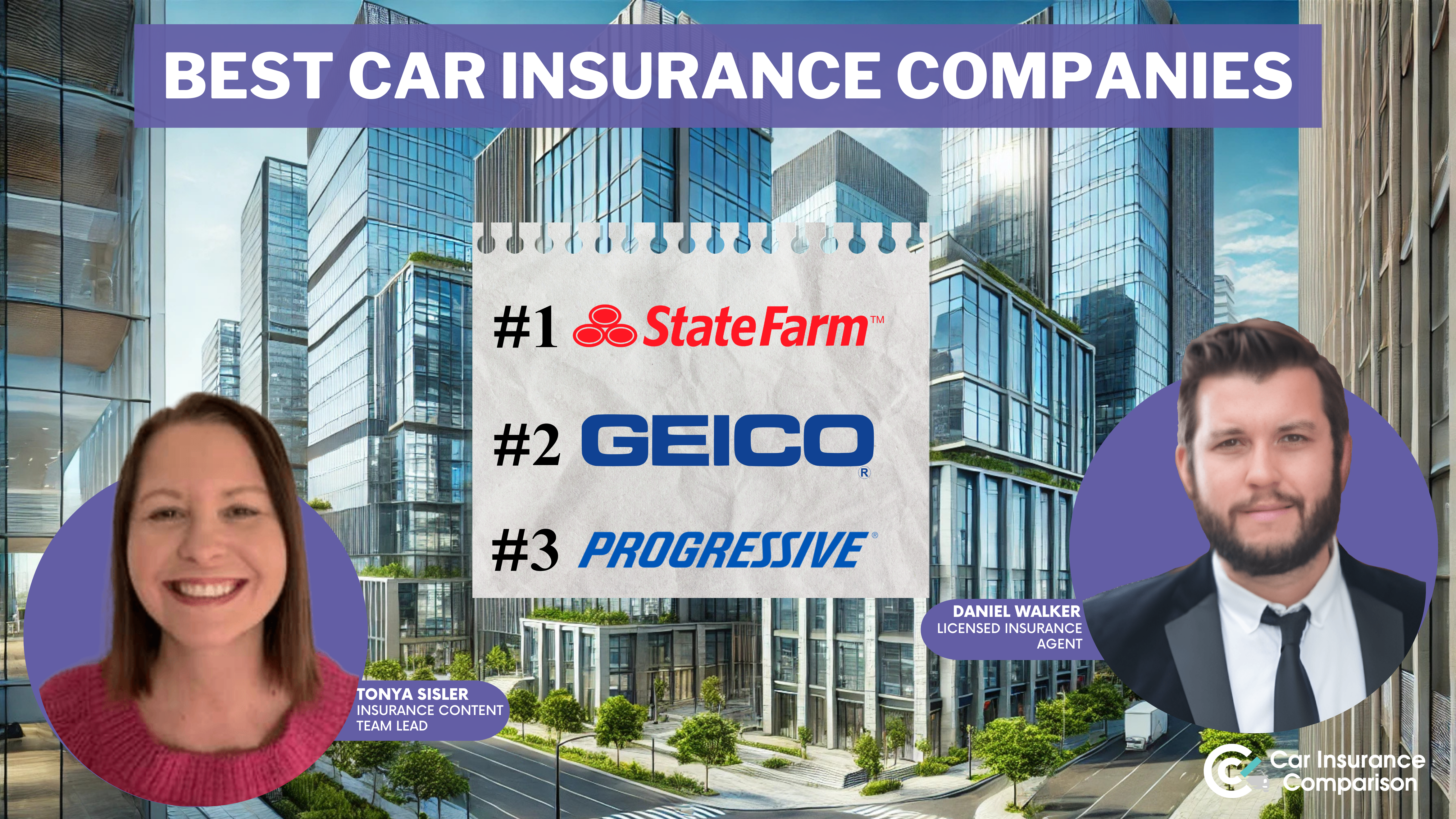
State Farm, Geico, and Progressive top the list of best car insurance companies, offering comprehensive plans starting at just $22 per month. Distinguished for their affordability, extensive coverage options, and exceptional customer service, these companies set the gold standard in the car insurance industry.
Read more





Find the Lowest Car Insurance Rates Today
Quote’s drivers have found rates as low as $42/month in the last few days!




Table of Contents
Table of Contents

Insurance Content Team Lead
Tonya Sisler has been a technical insurance writer for over five years. She uses her extensive insurance and finance knowledge to write informative articles that answer readers' top questions. Her mission is to provide readers with timely, accurate information that allows them to determine their insurance needs and choose the best coverage. Tonya currently leads a team of 10 insurance copywrite...
Tonya Sisler

Licensed Insurance Agent
Daniel Walker graduated with a BS in Administrative Management in 2005 and has run his family’s insurance agency, FCI Agency, for over 15 years (BBB A+). He is licensed as an insurance agent to write property and casualty insurance, including home, life, auto, umbrella, and dwelling fire insurance. He’s also been featured on sites like Reviews.com and Safeco. To ensure our content is accura...
Daniel Walker
Updated January 2025
 18,157 reviews
Company Facts
Full Coverage
A.M. Best Rating
Complaint Level
Pros & Cons
18,157 reviews 19,116 reviews
Company Facts
Full Coverage
A.M. Best Rating
Complaint Level
Pros & Cons
19,116 reviews 13,285 reviews
Company Facts
Full Coverage
A.M. Best Rating
Complaint Level
Pros & Cons
13,285 reviews
The top picks among the best car insurance companies are State Farm, Geico, and Progressive. These companies stand out for their robust coverage options.
Easily compare top car insurance companies online and find the best policy for you with our help. Everyone deserves the best coverage.
Chubb Car Insurance Monthly Rates vs. Top Competitors by Coverage Level
| Company | Rank | Monthly Rate | A.M. Best | Best For | Jump to Pros/Cons |
|---|---|---|---|---|---|
 | #1 | $22 | A++ | Military Savings | USAA |
 | #2 | $30 | A++ | Safe Driving | Geico |
 | #3 | $33 | B | Personalized Service | State Farm |
 | #4 | $37 | A++ | Claims Service | Travelers |
 | #5 | $39 | A+ | Customer Service | Progressive |
 | #6 | $44 | A | Quick Claims Service | American Family |
 | #7 | $44 | A+ | SmartRide Program | Nationwide |
 | #8 | $53 | A | Customizable Policies | Farmers |
 | #9 | $61 | A+ | Add-on Coverages | Allstate |
 | #10 | $68 | A | Add-on Coverage | Liberty Mutual |
It’s important to revisit your car insurance options, especially if it’s been years since you last checked. Updating your coverage with the best providers could be worthwhile.
Get the right car insurance at the best price — enter your ZIP code above to shop for coverage from the top insurers.
- State Farm leads as the top pick among the best car insurance companies
- Explore tailored coverage options that meet diverse driving needs and budgets
- Discover providers that offer superior claims service and customer support
- Car Insurance Company Comparison
- Esurance Car Insurance Review for 2026 [Rates, Discounts & More!]
- American Modern Car Insurance Review for 2026 [See Policies & Prices Here!]
- Ag Workers Mutual Car Insurance Review for 2026 [See if They’re a Good Fit]
- SafeAuto Car Insurance Review for 2026 [Expert Evaluation]
- Costco Car Insurance Review for 2026 [Comprehensive Overview]
- Cincinnati Insurance Car Insurance Review for 2026 [See if It’s a Good Fit]
- Shelter Car Insurance Review for 2026 [Honest Report]
- Anchor General Car Insurance Review for 2026 [Get the Facts Here]
- Horace Mann Car Insurance Review for 2026 [Comprehensive Overview]
- CURE Car Insurance Review for 2026 [See How Much You Can Save]
- GoAuto Car Insurance Review for 2026 [Trustworthy Evaluation]
- NJM Car Insurance Review for 2026 [Unbiased Evaluation]
- Kemper Car Insurance Review for 2026 [Rates, Discounts, & Options]
- Lemonade Car Insurance Review for 2026 [Trustworthy Evaluation]
- Metromile Car Insurance Review for 2026 [What Customers Have to Say]
- State Auto Insurance Review for 2026 [Unbiased Evaluation]
- Chubb Car Insurance Review for 2026 (See If They’re a Good Fit)
- Hanover Car Insurance Review for 2026 [Trustworthy Evaluation]
- American Access Car Insurance Review for 2026 [Cost & Coverage]
- Nationwide Car Insurance Review for 2026 [Customer & Financial Ratings]
- Mile Auto Insurance Review for 2026 [Company Report]
- Amica Car Insurance Review for 2026 [See Their Cost & Ratings]
- Enterprise Rental Car Insurance Review [2026]
- National Rental Car Insurance Review [2026]
- Thrifty Rental Car Insurance Review [2026]
- Alamo Rental Car Insurance Review [2026]
- Esurance vs. Allstate Car Insurance Comparison [2026]
- Safeco RightTrack App Review: Compare Rates, Discounts, & Requirements [2026]
- Safeco Car Insurance Review [2026]
- Auto-Owners Car Insurance Review [2026]
- Cheap Car Insurance After an At-Fault Accident in 2026(Save Money With These 10 Providers!)
- Buying Car Insurance for Your New Car
- National General Car Insurance Review [2026]
- Erie Car Insurance Review [2026]
- Direct Auto Car Insurance Review [2026]
- Texas Farm Bureau Car Insurance Review for 2026 [See Ratings & Cost Here!]
- MCA Car Insurance Review [2026]
- A-Max Car Insurance Review [2026]
- Plymouth Rock Car Insurance Review [2026]
- Country-Wide Car Insurance Review [2026]
- Green Light Car Insurance Review [2026]
- Worst Car Insurance Companies in America (2026 Update)
- Travelers Car Insurance Review [2026]
- The Grange Car Insurance Review [2026]
- The General Car Insurance Review [2026]
- State Farm Car Insurance Review for 2026 [See if They’re a Good Fit]
- Magnum Car Insurance Review [2026]
- Dairyland Car Insurance Review [2026]
- Geico Defensive Driving Course Review: Compare Rates, Discounts, & Requirements [2026]
- Hippo Car Insurance Review [2026]
- Western General Car Insurance Review [2026]
- Rivian Car Insurance Review [2026]
- USAA GAP Insurance Review: Compare Rates, Discounts, & Requirements [2026]
- Allstate Drivewise Review: Compare Rates, Discounts, & Requirements [2026]
- Farmers Signal Review: Compare Rates, Discounts, & Requirements [2026]
- American Family Insurance KnowYourDrive Review: Compare Rates, Discounts, & Requirements [2026]
- Noblr Car Insurance Review [2026]
- Say Car Insurance Review [2026]
- Clearcover Car Insurance Review [2026]
- Allstate Car Insurance Review for 2026 [See Rates & Discounts Here]
- 21st Century vs. USAA Car Insurance Comparison [2026]
- AARP Auto Insurance Program from The Hartford Review: Compare Rates, Discounts, & Requirements [2026]
- Ameriprise vs. The Hanover Car Insurance Comparison [2026]
- Amica vs. The Hartford Car Insurance Comparison [2026]
- Ameriprise vs. USAA Car Insurance Comparison [2026]
- American Family vs. Safeco Car Insurance Comparison [2026]
- American Family vs. Safe Auto Car Insurance Comparison [2026]
- Allstate vs. The Hartford Car Insurance Comparison [2026]
- AAA vs. The Hartford Car Insurance Comparison [2026]
- AAA vs. Safeco Car Insurance Comparison [2026]
- Allstate vs. Safeco Car Insurance Comparison [2026]
- American Family vs. Country Financial Car Insurance Comparison [2026]
- American Family vs. Amica Car Insurance Comparison [2026]
- Progressive vs. Travelers Car Insurance Comparison [2026]
- Liberty Mutual vs. Travelers Car Insurance Comparison [2026]
- Farmers vs. Travelers Car Insurance Comparison [2026]
- Farmers vs. The Hartford Car Insurance Comparison [2026]
- Farmers vs. MetLife Car Insurance Comparison [2026]
- 21st Century vs. Amica Car Insurance Comparison [2026]
- Geico vs. The Hartford Car Insurance Comparison [2026]
- Geico vs. The General Car Insurance for 2026 [Compare Cost & Plans Here!]
- Geico vs. Liberty Mutual Car Insurance Comparison [2026]
- Liberty Mutual Car Insurance Review for 2026 [See Rates & Discounts Here]
- USAA Car Insurance Review for 2026 [Rates, Discounts, & Options]
- Root Car Insurance Review for 2026 [See Rates & Discounts Here]
- Progressive Car Insurance Review for 2026 [See if They’re a Good Fit]
- Farmers Car Insurance Review [2026]
- Geico Car Insurance Review for 2026 [See if They’re a Good Fit]
- AAA Car Insurance Review for 2026 (Uncover Rates and Discounts Here)
- Car Insurance Company Comparison (2026 Ranking)
- American Family Car Insurance Review [2026]
- Prudential Car Insurance Review [2026]
- Gabi Car Insurance Review [2026]
- MAPFRE Car Insurance Review [2026]
- American Auto Shield Car Insurance Review [2026]
- Geico vs. AAA Car Insurance in 2026 [Compare Costs & Options!]
- Esurance vs. Geico vs. Progressive Car Insurance Comparison [2026]
- Auto Club Group Car Insurance Review [2026]
- Citizens Insurance Michigan Car Insurance Review [2026]
- Where to Find Car Insurance Company Reviews [2026]
- Compare Ford vs. Chevrolet Car Insurance Rates [2026]
- Nationwide Car Insurance Discounts [2026]
- EMC Car Insurance Review [2026]
- State Farm vs. Progressive Car Insurance Comparison [2026]
- Geico vs. Allstate Car Insurance Comparison [2026]
- Allstate vs. State Farm Car Insurance Comparison [2026]
- Kaiser Permanente Car Insurance Review [2026]
- Assurant Car Insurance Review [2026]
- Colonial Penn Car Insurance Review [2026]
- Aflac Car Insurance Review [2026]
- Blue Cross Blue Shield Car Insurance Review [2026]
- Humana Car Insurance Review [2026]
- United Healthcare Car Insurance Review [2026]
- Best Car Insurance Comparison Websites [2026]
- Viking Car Insurance Review [2026]
- Virginia Surety Car Insurance Review [2026]
- St. Paul Protective Car Insurance Review [2026]
- Compare Canadian vs. US Car Insurance: Rates, Discounts, & Requirements [2026]
- Truck Insurance Exchange Car Insurance Review [2026]
- Omaha Indemnity Car Insurance Review [2026]
- Mitsui Sumitomo Car Insurance Review [2026]
- Lyndon Car Insurance Review [2026]
- Mid Century Car Insurance Review [2026]
- MGA Car Insurance Review [2026]
- Mendakota Car Insurance Review [2026]
- Interinsurance Exchange Car Insurance Review [2026]
- GHS Car Insurance Review [2026]
- Germania Car Insurance Review [2026]
- Gateway Car Insurance Review [2026]
- Caterpillar Car Insurance Review [2026]
- Cumis Car Insurance Review [2026]
- American Standard Car Insurance Review [2026]
- BCS Insurance Car Insurance Review [2026]
- Central National Car Insurance Review [2026]
- AutoOne Car Insurance Review [2026]
- Advanta Car Insurance Review [2026]
- American Mercury Car Insurance Review [2026]
- American Interstate Car Insurance Review [2026]
- American Farmers Ranchers Car Insurance Review [2026]
- American Road Car Insurance Review [2026]
- Hertz Rental Car Insurance Review [2026]
- Wawanesa Car Insurance Review [2026]
- Direct Line Car Insurance Review [2026]
- Mountain Valley Indemnity Company Car Insurance Review [2026]
- General Security National Insurance Company Car Insurance Review [2026]
- Everest Car Insurance Review [2026]
- American Alternative Insurance Corporation Car Insurance Review [2026]
- Economy Premier Assurance Car Insurance Review [2026]
- Aetna life Car Insurance Review [2026]
- Homesite Car Insurance Review [2026]
- Lloyds Car Insurance Review [2026]
- Massachusetts Bay Car Insurance Review [2026]
- Northern Assurance Car Insurance Review [2026]
- OneBeacon Car Insurance Review [2026]
- Essentia Car Insurance Review [2026]
- First National Car Insurance Review [2026]
- Amica vs. Progressive Car Insurance Comparison [2026]
- Progressive vs. USAA Car Insurance Comparison [2026]
- AAA vs. Nationwide Car Insurance Comparison [2026]
- AAA vs. Liberty Mutual Car Insurance Comparison [2026]
- State Farm vs. Liberty Mutual Car Insurance Comparison [2026]
- State Farm vs. AAA Car Insurance Comparison [2026]
- Amica vs. AAA Car Insurance in 2026 [Side-by-Side Comparison]
- Liberty Mutual vs. USAA Car Insurance Comparison [2026]
- Allstate vs. AAA Car Insurance Comparison [2026]
- Allstate vs. Nationwide Car Insurance Comparison [2026]
- Allstate vs. Amica Car Insurance Comparison [2026]
- Amica vs. Nationwide Car Insurance Comparison [2026]
- Esurance vs. Liberty Mutual Car Insurance Comparison [2026]
- Progressive vs. AAA Car Insurance Comparison [2026]
- Progressive vs. Farmers Car Insurance Comparison [2026]
- AAA vs. Farmers Car Insurance Comparison [2026]
- AAA vs. USAA Car Insurance Comparison [2026]
- AIS Car Insurance Review for 2026 [Ratings, Cost, & Complaints]
- Mercer Insurance Group Car Insurance Review [2026] [Redirected 11/19/25]
- Hagerty Car Insurance Review [2026]
- Esurance vs. Allstate Car Insurance Comparison [2026]
- Cheap Car Insurance After an At-Fault Accident in 2026(Save Money With These 10 Providers!)
- Worst Car Insurance Companies in America (2026 Update)
- Geico Defensive Driving Course Review: Compare Rates, Discounts, & Requirements [2026]
- USAA GAP Insurance Review: Compare Rates, Discounts, & Requirements [2026]
- Farmers Signal Review: Compare Rates, Discounts, & Requirements [2026]
- American Family Insurance KnowYourDrive Review: Compare Rates, Discounts, & Requirements [2026]
- 21st Century vs. USAA Car Insurance Comparison [2026]
- Ameriprise vs. The Hanover Car Insurance Comparison [2026]
- Amica vs. The Hartford Car Insurance Comparison [2026]
- Ameriprise vs. USAA Car Insurance Comparison [2026]
- American Family vs. Safeco Car Insurance Comparison [2026]
- American Family vs. Safe Auto Car Insurance Comparison [2026]
- Allstate vs. The Hartford Car Insurance Comparison [2026]
- AAA vs. The Hartford Car Insurance Comparison [2026]
- AAA vs. Safeco Car Insurance Comparison [2026]
- Allstate vs. Safeco Car Insurance Comparison [2026]
- American Family vs. Country Financial Car Insurance Comparison [2026]
- American Family vs. Amica Car Insurance Comparison [2026]
- Progressive vs. Travelers Car Insurance Comparison [2026]
- Liberty Mutual vs. Travelers Car Insurance Comparison [2026]
- Farmers vs. Travelers Car Insurance Comparison [2026]
- Farmers vs. The Hartford Car Insurance Comparison [2026]
- Farmers vs. MetLife Car Insurance Comparison [2026]
- 21st Century vs. Amica Car Insurance Comparison [2026]
- Geico vs. The Hartford Car Insurance Comparison [2026]
- Geico vs. The General Car Insurance for 2026 [Compare Cost & Plans Here!]
- Geico vs. Liberty Mutual Car Insurance Comparison [2026]
- Car Insurance Company Comparison (2026 Ranking)
- Geico vs. AAA Car Insurance in 2026 [Compare Costs & Options!]
- Esurance vs. Geico vs. Progressive Car Insurance Comparison [2026]
- Compare Ford vs. Chevrolet Car Insurance Rates [2026]
- Nationwide Car Insurance Discounts [2026]
- State Farm vs. Progressive Car Insurance Comparison [2026]
- Geico vs. Allstate Car Insurance Comparison [2026]
- Allstate vs. State Farm Car Insurance Comparison [2026]
- Compare Canadian vs. US Car Insurance: Rates, Discounts, & Requirements [2026]
- Amica vs. Progressive Car Insurance Comparison [2026]
- Progressive vs. USAA Car Insurance Comparison [2026]
- AAA vs. Nationwide Car Insurance Comparison [2026]
- AAA vs. Liberty Mutual Car Insurance Comparison [2026]
- State Farm vs. Liberty Mutual Car Insurance Comparison [2026]
- State Farm vs. AAA Car Insurance Comparison [2026]
- Amica vs. AAA Car Insurance in 2026 [Side-by-Side Comparison]
- Liberty Mutual vs. USAA Car Insurance Comparison [2026]
- Allstate vs. AAA Car Insurance Comparison [2026]
- Allstate vs. Nationwide Car Insurance Comparison [2026]
- Allstate vs. Amica Car Insurance Comparison [2026]
- Amica vs. Nationwide Car Insurance Comparison [2026]
- Esurance vs. Liberty Mutual Car Insurance Comparison [2026]
- Progressive vs. AAA Car Insurance Comparison [2026]
- Progressive vs. Farmers Car Insurance Comparison [2026]
- AAA vs. Farmers Car Insurance Comparison [2026]
- AAA vs. USAA Car Insurance Comparison [2026]
- Best Car Insurance by Coverage Type
- Best Personal Accident Insurance in 2026 (Compare the Top 10 Companies)
- Best Full Coverage Car Insurance in 2026 (Top 10 Companies Ranked)
- 10 Best Car Insurance Companies for Drivers With Speeding Tickets in 2026
- 10 Best Commercial Car Insurance Companies in 2026
- Best Tesla Car Insurance Rates in 2026 (Compare The Top 10 Companies)
- 8 Best Car Insurance Companies That Accept Felons in 2026
- 10 Best Car Insurance Companies That Accept Cash App in 2026
- Best Car Insurance for Company Vehicles in 2026 (Top 10 Providers)
- Best Car Insurance Companies That Offer Cash Back in 2026 (Top 10 Providers)
- 10 Best Car Insurance Companies That Accept Suspended Licenses in 2026
- Best Car Insurance Companies That Don’t Report to the DMV in 2026 (Top 10 Providers)
- Best Car Insurance Companies That Cover OEM Parts in 2026 (Top 10 Providers)
- Cheap Car Insurance Companies That Insure Salvage Title Vehicles in 2026 (Top 10 Providers)
- Best Car Insurance Companies That Offer Agreed Value in 2026 (Top 10 Providers)
- 10 Best Car Insurance Companies for DUI Offenders in 2026
- Best Car Insurance for Married Couples on Separate Policies in 2026 (Top 10 Providers)
- 10 Best Companies That Insure Cars With Blown Airbags in 2026
- Cheap Car Insurance Companies That Beat Quotes in 2026 (10 Most Affordable Providers)
- Best Car Insurance for Modified Cars in 2026 (Your Guide to the Top 10 Companies)
- Best Car Insurance for Multiple Accidents in 2026 (Top 10 Providers)
- Best Insurance for Car Rental Businesses in 2026 (Top 10 Providers)
- Best Car Insurance Companies That Only Look Back 3 Years in 2026 (Top 10 Picks)
- Best Car Insurance for Unlicensed Drivers in 2026 (Top 10 Providers)
- 10 Best Car Insurance Companies That Allow Spouse Exclusions in 2026
- Best Car Insurance Companies for Financed Cars in 2026
- 10 Best Car Insurance Companies for High-Risk Drivers in 2026
- Best Car Insurance for High-Risk Drivers in 2026 (Top 8 Companies Ranked)
- Car Subscription Services: A Comprehensive Guide [2026]
- Compare Car Insurance for Business Leases: Rates, Discounts, & Requirements [2026]
- 10 Best Classic Car Insurance Companies in 2026
- What are private-passenger car insurance companies?
- 10 Best Car Insurance Companies for Families in 2026
- 10 Best Car Insurance Companies in Canada for 2026
- Traits of the Worst Car Insurance Companies
- Best Car Insurance Companies in 2026
- Best Car Insurance for Car Dealerships in 2026 (Top 10 Companies Ranked)
- Best Car Insurance Companies That Don’t Use Credit Scores in 2026 (Top 10 Providers)
- What is the best car insurance?
- Compare the Best Car Insurance Companies
- Best Car Insurance by Occupation
- Cheap Car Insurance for Pilots and Navigators in 2026 (Top 10 Affordable Companies)
- Best Car Insurance for Pharmacists in 2026 (Top 10 Companies)
- How Occupation Affects Car Insurance Rates (Education, Discounts, & Rates)
- Cheap Taxi Car Insurance in 2026 (Top 10 Companies)
- Best Car Insurance for Home-Care Worker in 2026 (Top 10 Companies)
- Best Car Insurance for Diplomats in 2026 (Top 10 Companies)
- Best Car Insurance for Emergency Service Workers in 2026 (Top 10 Companies)
- Can I get car insurance without having a job?
- Best Car Insurance for Social Workers in 2026 (Top 10 Companies)
- Best Car Insurance for Doctors in 2026 (Top 10 Companies)
- Best Car Insurance for Accountants in 2026 (Top 10 Companies)
- Best Car Insurance When Self-Employed in 2026 (Top 10 Companies)
- Best Car Insurance for Security and Prison Workers in 2026 (Top 10 Companies)
- Best Car Insurance for Drivers Without a College Degree in 2024 (Top 10 Companies)
- Best Car Insurance for Church Employees in 2026 (Top 10 Companies)
- Best Car Insurance for Customer Service Occupations in 2026 (Top 10 Companies)
- Best Car Insurance for Healthcare Workers in 2026 (Top 10 Companies)
- Best Car Insurance for Managers and Directors in 2026 (Top 10 Companies)
- Best Car Insurance for Nannies in 2026 (Top 10 Companies)
- Best Car Insurance for Real Estate Agents in 2026 (Top 10 Companies)
- Best Car Insurance for Engineers in 2026 (Top 10 Companies)
- Best Car Insurance for Homemakers in 2026 (We Suggest These 10 Companies)
- Best Car Insurance for Scientists in 2026 (Top 10 Companies)
- Best Car Insurance for Students in 2026 (Top 10 Companies)
- Best Car Insurance for Unemployed Drivers in 2026 (Top 10 Companies)
- Best Car Insurance for Driving Instructors in 2026 (Top 10 Companies)
- Best Car Insurance for Independent Contractors in 2026 (Top 10 Companies)
- Best Car Insurance for Union Members in 2026 (Top 10 Companies)
- Cheap Car Insurance for Pilots and Navigators in 2026 (Top 10 Affordable Companies)
- Best Car Insurance for Pharmacists in 2026 (Top 10 Companies)
- How Occupation Affects Car Insurance Rates (Education, Discounts, & Rates)
- Cheap Taxi Car Insurance in 2026 (Top 10 Companies)
- Best Car Insurance for Home-Care Worker in 2026 (Top 10 Companies)
- Best Car Insurance for Diplomats in 2026 (Top 10 Companies)
- Best Car Insurance for Emergency Service Workers in 2026 (Top 10 Companies)
- Can I get car insurance without having a job?
- Best Car Insurance for Social Workers in 2026 (Top 10 Companies)
- Best Car Insurance for Doctors in 2026 (Top 10 Companies)
- Best Car Insurance for Accountants in 2026 (Top 10 Companies)
- Best Car Insurance When Self-Employed in 2026 (Top 10 Companies)
- Best Car Insurance for Security and Prison Workers in 2026 (Top 10 Companies)
- Best Car Insurance for Drivers Without a College Degree in 2024 (Top 10 Companies)
- Best Car Insurance for Church Employees in 2026 (Top 10 Companies)
- Best Car Insurance for Customer Service Occupations in 2026 (Top 10 Companies)
- Best Car Insurance for Healthcare Workers in 2026 (Top 10 Companies)
- Best Car Insurance for Managers and Directors in 2026 (Top 10 Companies)
- Best Car Insurance for Nannies in 2026 (Top 10 Companies)
- Best Car Insurance for Real Estate Agents in 2026 (Top 10 Companies)
- Best Car Insurance for Engineers in 2026 (Top 10 Companies)
- Best Car Insurance for Homemakers in 2026 (We Suggest These 10 Companies)
- Best Car Insurance for Scientists in 2026 (Top 10 Companies)
- Best Car Insurance for Students in 2026 (Top 10 Companies)
- Best Car Insurance for Unemployed Drivers in 2026 (Top 10 Companies)
- Best Car Insurance for Driving Instructors in 2026 (Top 10 Companies)
- Best Car Insurance for Independent Contractors in 2026 (Top 10 Companies)
- Best Car Insurance for Union Members in 2026 (Top 10 Companies)
- Best Car Insurance for Hobbyists
- Best Track Day Car Insurance in 2026 (Top 10 Companies)
- The Best Classic Car Auctions [2026]
- Best Vehicle Shipping Insurance in 2026 (Top 10 Companies)
- Best Car Insurance for Road Trips in 2026 (Top 10 Companies)
- Insurance Auto Auction: Explained Simply
- Best Car Insurance for Natural Disasters in 2026 (Your Guide to the Top 10 Companies)
- How to Handle Car Insurance When Moving Out of State in 2026 [6 Easy Steps to Follow]
- Best Track Day Car Insurance in 2026 (Top 10 Companies)
- The Best Classic Car Auctions [2026]
- Best Vehicle Shipping Insurance in 2026 (Top 10 Companies)
- Best Car Insurance for Road Trips in 2026 (Top 10 Companies)
- Insurance Auto Auction: Explained Simply
- Best Car Insurance for Natural Disasters in 2026 (Your Guide to the Top 10 Companies)
- How to Handle Car Insurance When Moving Out of State in 2026 [6 Easy Steps to Follow]
- Best Car Insurance by Vehicle
- Cheap Car Insurance for a Second Car in 2026 (Earn Savings With These 10 Companies!)
- The Best Small Car Safety Ratings for 2026
- Compare 1980s Vehicle Insurance Rates [2026]
- Best Affordable Classic Cars
- Compare Car Insurance Rates for WW2 Vehicles [2026]
- Best Low-Mileage Car Insurance in 2026 (Your Guide to the Top 10 Providers)
- Cheap Classic Car Insurance Without a Garage in 2026 (10 Most Affordable Companies)
- Cheap Car Insurance for Wheelchair-Accessible Vehicles in 2026 (Save Big With These 10 Companies!)
- Does car insurance cover engine failure?
- Car Insurance for Electric Cars
- Best Rally Car Insurance in 2026 (Find the Top 10 Companies Here!)
- Cheap Insurance for Car Auctions in 2026 (Cash Savings With These 8 Companies!)
- Why do you need GAP insurance for a leased car?
- Cheap Car Insurance for Older Vehicles in 2026 (Save Money With These 8 Companies)
- Cheap Car Insurance for a Second Car in 2026 (Earn Savings With These 10 Companies!)
- The Best Small Car Safety Ratings for 2026
- Compare 1980s Vehicle Insurance Rates [2026]
- Best Affordable Classic Cars
- Compare Car Insurance Rates for WW2 Vehicles [2026]
- Best Low-Mileage Car Insurance in 2026 (Your Guide to the Top 10 Providers)
- Cheap Classic Car Insurance Without a Garage in 2026 (10 Most Affordable Companies)
- Cheap Car Insurance for Wheelchair-Accessible Vehicles in 2026 (Save Big With These 10 Companies!)
- Does car insurance cover engine failure?
- Car Insurance for Electric Cars
- Best Rally Car Insurance in 2026 (Find the Top 10 Companies Here!)
- Cheap Insurance for Car Auctions in 2026 (Cash Savings With These 8 Companies!)
- Why do you need GAP insurance for a leased car?
- Cheap Car Insurance for Older Vehicles in 2026 (Save Money With These 8 Companies)
#1 – State Farm: Top Overall Pick
Pros
- Bundling Policies: State Farm offers significant discounts for bundling multiple insurance policies. Learn more in our State farm car insurance review.
- High Low-Mileage Discount: State Farm provides a substantial discount for low-mileage usage.
- Wide Coverage: State Farm offers various coverage options tailored for different business needs.
Cons
- Limited Multi-Policy Discount: The multi-policy discount of State Farm is not as high compared to some competitors.
- Premium Costs: Despite discounts, State Farm’s premiums might still be relatively higher for certain coverage levels.
Free Insurance Comparison
Compare Quotes From Top Companies and Save
#2 – Geico: Best for Coverage Options
Pros
- High Safe Driving Discount: Geico offers a 24% discount for safe drivers, one of the highest in the industry.
- Extensive Coverage Options: Provides a wide range of coverage types, including mechanical breakdown insurance.
- Fast Claims Process: Known for a quick and efficient claims resolution process. See more details on our Geico car insurance review.
Cons
- Customer Service Variability: Customer service quality can vary significantly by region.
- Pricing Fluctuations: Some customers report inconsistent pricing at renewal.
#3 – Progressive: Best for Customer Service
Pros
- Highest Safe Driving Discount: Progressive leads with a 28% discount for safe driving.
- Loyalty Rewards: Offers benefits like small accident forgiveness as part of its loyalty rewards program.
- Flexible Policies: Provides flexibility in customizing policies and choosing payment schedules. More information is available about this provider in our Progressive car insurance ieview.
Cons
- Higher Rates for Riskier Drivers: Rates can be significantly higher for high-risk drivers.
- Inconsistent Agent Experiences: Experiences can vary depending on the agent or representative.
#4 – Allstate: Best for Add-on Coverages
Pros
- Multiple Add-Ons: Allstate offers several unique add-ons, such as new car replacement and custom equipment coverage. Read up on the Progressive car insurance review.
- Safe Driving Club: Rewards safe drivers with discounts and other benefits through its Safe Driving Club.
- Effective Online Tools: Provides robust online tools and apps for policy management.
Cons
- Higher Premiums: Tends to have higher premiums compared to competitors.
- Complex Policy Options: Some customers find policy options and add-ons complex and difficult to understand.
Free Insurance Comparison
Compare Quotes From Top Companies and Save
#5 – USAA: Best for Military Savings
Pros
- Dedicated to Military: Tailored services and discounts specifically for military members and their families. Check out insurance savings in our complete USAA car insurance review.
- Consistently High Ratings: USAA regularly receives high marks for customer service and claims satisfaction.
- Comprehensive Coverage: Offers comprehensive coverage that often exceeds competitors at similar or lower rates.
Cons
- Limited Availability: Only available to military members, veterans, and their families.
- Fewer Physical Locations: Limited physical branches which may affect those preferring in-person service.
#6 – Liberty Mutual: Best for Add-on Coverage
Pros
- Customizable Add-Ons: Offers extensive add-on options, including accident forgiveness and lifetime repair guarantee.
- Diverse Discounts: Provides a wide array of discounts, such as for hybrid/electric cars and good students.
- Strong Global Presence: Extensive support network and services available globally. Discover more about offerings in our Liberty Mutual car insurance review.
Cons
- Variable Customer Satisfaction: Customer satisfaction ratings can be inconsistent across different regions.
- Pricing Above Average: Some customers report higher than average pricing.
#7 – Nationwide: Best for SmartRide Program
Pros
- SmartRide Discount: Offers discounts for safe driving through its telematics-based SmartRide program.
- Wide Range of Products: Provides a broad range of insurance products, making it easy to bundle services.
- Strong Financial Stability: Maintains a strong financial status with high ratings from A.M. Best. Access comprehensive insights into our Nationwide car insurance discounts.
Cons
- Customer Service Issues: Some policyholders report less than satisfactory experiences with customer service.
- Claims Process: The claims process can sometimes be slower compared to industry leaders.
Free Insurance Comparison
Compare Quotes From Top Companies and Save
#8 – Farmers: Best for Customizable Policies
Pros
- Highly Customizable Policies: Allows extensive customization of policies to fit individual needs.
- Proactive Claims Service: Known for proactive management and resolution of claims. Delve into our evaluation of Farmers car insurance review.
- Innovative Home Coverage: Offers unique home insurance options that can be bundled with auto for savings.
Cons
- Higher Cost: Generally more expensive than some other competitors.
- Complexity in Policy Management: Some users find managing their policies through online portals to be complex.
#9 – Travelers: Best for Comprehensive Coverage
Pros
- Broad Coverage Options: Offers some of the most comprehensive coverage options available. Unlock details in our Travelers car insurance review.
- Green Home Discount: Provides discounts for certified green homes and hybrid/electric vehicles.
- Excellent Risk Assessment Tools: Offers superior risk assessment tools to tailor coverage needs accurately.
Cons
- Higher Premiums for Some Policies: Premiums can be on the higher side for certain policies.
- Limited Discount Opportunities: Fewer discount options compared to other top insurers.
#10 – American Family: Best for Claims Service
Pros
- Focused on Claims Satisfaction: Emphasizes superior claims service and quick resolution. Discover insights in our American Family car insurance review.
- Bundling Options: Offers significant discounts for bundling auto with other types of insurance.
- Diverse Policy Offerings: Wide range of policy options catering to diverse customer needs.
Cons
- Geographical Limitations: Not available in all states, which can limit availability for some customers.
- Premium Variability: Some customers report variability in premium rates at renewal time.
Free Insurance Comparison
Compare Quotes From Top Companies and Save
Comparative Monthly Rates for Leading Car Insurers
When assessing car insurance options, it’s essential to consider the monthly rates for both minimum and full coverage across various providers. The table below illustrates a comparison among top insurers, showing a significant range in pricing for both types of coverage. Learn more in our “Compare Monthly Car Insurance: Rates, Discounts, & Requirements.”
Car Insurance Monthly Rates by Coverage Level & Provider
| Insurance Company | Minimum Coverage | Full Coverage |
|---|---|---|
| Allstate | $61 | $160 |
| American Family | $44 | $117 |
| Farmers | $53 | $139 |
| Geico | $30 | $80 |
| Liberty Mutual | $68 | $174 |
| Nationwide | $44 | $115 |
| Progressive | $39 | $105 |
| State Farm | $33 | $86 |
| Travelers | $37 | $99 |
| USAA | $22 | $59 |
Allstate, Liberty Mutual, and USAA present varying rates with Allstate charging $61 for minimum coverage and $160 for full coverage, positioning it at a higher pricing bracket.
On the other end, USAA offers the most competitive rates at $22 for minimum and $59 for full coverage, particularly favorable for military families.
Geico also stands out with remarkably low rates of $30 for minimum and $80 for full coverage, making it an appealing choice for budget-conscious consumers. Each company’s rates reflect their unique value propositions, catering to different segments of the market based on coverage needs and financial flexibility.
Compare the Best Car Insurance Companies in the Nation
You’ve seen the commercials: mayhem, disasters, flying pigs.
Flying pigs? Yep, according to Farmers
We’ve seen it and covered it.
What about your neighbors? Are you really in good hands? I haven’t seen any cavemen lately, but can I really save 15% with a ten-minute phone call?
Maybe. But which is actually the best? What are the 10 best insurance companies? We’ve got the complete buyer’s guide to who’s the best.
Check our car insurance comparison chart below to see how the biggest auto insurance companies measure up in four core categories: availability and rates, financial stability, reputation, and best company for you.
Car Insurance Comparison Chart
Here’s one important fact: the top 10 car insurance companies are licensed to operate in all 50 states except for American Family, Nationwide, and Travelers. Be sure and check out our company reviews if you are considering one of the companies above to see if it is available in your state.
The table below includes a list of the top 10 auto insurance companies, their average annual rate on a national scale compared to the national average, and their cheapest insured vehicle.
Top 10 Car Insurance Companies by Availability, Average Annual Rates, and Cheapest Car to Insure/strong>
| Insurance Company | Availability | Monthly Rates | Percent Higher/Lower Than Average | Cheapest Car to Insure |
|---|---|---|---|---|
| All 50 States and D.C. | $378 | 23.82% (Higher) | 2015 Toyota RAV-4 |
| 19 States | $308 | 1.03% (Higher) | 2015 Honda Civic |
| All 50 States and D.C. | $326 | 6.75% (Higher) | 2015 Toyota RAV-4 |
| All 50 States and D.C. | $256 | -16.04% (Lower) | 2015 Toyota RAV-4 |
| All 50 States and D.C. | $441 | 44.65% (Higher) | 2015 Toyota RAV-4 |
| 46 States and D.C. | $266 | -12.94% (Lower) | 2018 Toyota RAV-4 |
| All 50 States and D.C. | $328 | 7.5% (Higher) | 2015 Toyota RAV-4 |
| All 50 States and D.C. | $228 | -25.39% (Higher) | 2015 Honda Civic |
| 42 States and D.C. | $311 | 1.87% (Higher) | 2015 Ford F-150 |
| All 50 States and D.C. | $207 | -32% (Lower) | 2015 Honda Civic |
Read more:
- Liberty Mutual vs. USAA Car Insurance Comparison
- American Family vs. Safeco Car Insurance Comparison
- American Family vs. Safe Auto Car Insurance Comparison
- Amica vs. Nationwide Car Insurance Comparison
- Allstate vs. Safeco Car Insurance Comparison
- Allstate vs. State Farm Car Insurance Comparison
- Allstate vs. The Hartford Car Insurance Comparison
- AAA vs. Nationwide Car Insurance Comparison
- Geico vs. AAA Car Insurance Comparison
- Liberty Mutual vs. Travelers Car Insurance Comparison
- Progressive vs. Travelers Car Insurance Comparison
- State Farm vs. Liberty Mutual Car Insurance Comparison
- Compare Best Car Insurance Companies That Only Look Back Three Years
- Farmers vs. MetLife Car Insurance Comparison
- Farmers vs. The Hartford Car Insurance Comparison
- Farmers vs. Travelers Car Insurance Comparison
Although the table shows USAA and State Farm have the lowest premiums, that doesn’t necessarily mean you should choose one of them as your provider without doing further research.
USAA has the lowest prices, but the company provides insurance for military personnel and their family members only. If you’re looking for car insurance discounts for military members, USAA may be the best option for you.
If you aren’t affiliated with the military, State Farm may be your next choice. But again, our research has shown that location and carrier, not price, are the most important factors when deciding on an insurance company.
Other factors, such as the laws in your state, marital status, and credit history, also play a role in the cost of your rates. We will cover all of these factors in this article.
For the best car insurance companies by claim settlement ratio, keep reading.
Free Insurance Comparison
Compare Quotes From Top Companies and Save
Compare the Best Car Insurance Companies by Financial Ratings
The future financial stability of a company can often be judged by its historic financial stability, especially in comparison to its top competitors. Also, third-party entities such as A.M. Best use an intricate algorithm to rate and predict the financial stability of a company.
The National Association of Insurance Commissioners (NAIC) releases an annual report that examines the financial stability of all car insurance companies. Here’s what you should look for:
- Direct Premiums Written: The total dollar amount in premiums received by an insurance company without any adjustments.
- Market Share: Indicates the degree (in percent) of market concentration in a line of business.
- Loss Ratio: A percent that represents the amount paid out on claims against what a company earns in premiums.
The table below shows these three figures for the top 10 companies in the car insurance market for 2018 and indicates whether they’re rising (↑), falling (↓), or remaining steady (~) based on NAIC data from 2015 through 2018.
Top 10 Car Insurance Companies by A.M. Best Rating, Market Share, & Loss Ratio
| Insurance Company | A.M. Best | Premiums Written | Market Share | Loss Ratio |
|---|---|---|---|---|
| A+ | $22.7 billion (↑) | 9.19% (↓) | 56% (↓) |
| A | $4.7 billion (↑) | 1.9% (↑) | 69% (~) |
| A | $10.5 billion (↑) | 4.26% (↓) | 61% (~) |
| A++ | $33.1 billion (↑) | 13.41% (↑) | 71% (~) |
| A | $11.8 billion (↑) | 4.77% (↓) | 62% (~) |
| A+ | $6.7 billion (↓) | 2.73% (↓) | 58% (↓) |
| A+ | $27.1 billion (↑) | 10.97% (↑) | 62% (~) |
| B | $41.9 billion (↑) | 17.01% (↓) | 63% (↓) |
| A++ | $4.7 billion (↑) | 1.9% (↑) | 60% (~) |
| A++ | $14.5 billion (↑) | 5.87% (↑) | 77% (~) |
Because loss ratios can fluctuate from year to year, the safest bet is if they stay in the 60-to-70% range. A loss ratio (or claim settlement ratio) lower than 60% shows the company is not paying out on enough claims. A loss ratio above 70% shows the company may be losing money, which long term can mean an increase in rates.
Read more:
Compare the Best Car Insurance Companies by Reputation
Saving money is nice, but what happens when you need to file a car insurance claim? When you’re looking for the best-rated car insurance companies, you certainly don’t want to rely on a company with a bad reputation when it comes to customer service.
When choosing (or changing) car insurance providers, it’s essential to examine the satisfaction of new customers and established customers who file a claim. Luckily, J.D. Power collects data on both.
J.D. Power is a well-known go-to source for customer ratings of all sorts. Over 40,000 participants complete their comprehensive surveys.
We share data here from two of their annual reviews: the U.S. Auto Claims Satisfaction Study and the Insurance Shopping Study. J.D. Power uses Power Circle Ratings. These ratings are calculated based on the range between the highest score and the lowest score (per survey item) and place a company in that range with one to five circles.
Five circles = among the best; one circle = the rest. J.D. Power may assign one or more power circles to any company; however, they publicly announce and publish only those ratings that are two power circles or higher.
More circles of trust are shown to mean a higher level of customer satisfaction, which is suitable for everyone, including Greg.
This table shows J.D. Power Circles (and translates them) awarded in two categories: satisfaction of new customers and satisfaction of customers that file a claim. J.D. Power awards Power Circles in many other categories as well.
Read more:
- Car Insurance Companies With the Worst Customer Satisfaction
- Truck Insurance Exchange Car Insurance Review
Top 10 Car Insurance Companies by J.D. Power Ratings: Shopping, Claims, and Complaint Ratio
| Insurance Company | Shopping Satisfaction | Claims Satisfaction | Complaint Ratio vs. Average (1.00) |
|---|---|---|---|
| 862/1,000 | 869/1,000 | 1.10 (Higher) |
| 854/1,000 | 887/1,000 | 0.98 (Lower) |
| 841/1,000 | 872/1,000 | 1.12 (Higher) |
| 853/1,000 | 885/1,000 | 1.03 (Higher) |
| 837/1,000 | 872/1,000 | 1.20 (Higher) |
| 848/1,000 | 882/1,000 | 1.00 (Average) |
| 841/1,000 | 859/1,000 | 1.15 (Higher) |
| 866/1,000 | 878/1,000 | 0.95 (Lower) |
| 849/1,000 | 879/1,000 | 1.05 (Higher) |
| 890/1,000 | 897/1,000 | 0.85 (Lower) |
The NAIC tracks official complaints about how car insurance companies do business. This agency calculates a complaint ratio for each company and compares it to the collective national complaint ratio.
The complaint ratio is determined by looking at the number of complaints per year per $1 million of premium earned by the total in annual premiums. In 2018, the collective national complaint ratio was 1.15; a rate lower than 1.15 is good, and one higher than 1.15 is not so good.
For example, USAA has some of the best rates in the country, and J.D. Power awarded them five Power Circles on handling claims. However, they have one of the highest complaint ratios, squeaking in right under the collective national complaint ratio of 1.15.
Progressive is in a similar situation, except J.D. Power awarded them three Power Circles on handling claims, though they are among the lowest in complaint ratio out of the top 10 companies.
Besides J.D. Power and NAIC, here are three other agencies that provide customer satisfaction ratings to help you choose the best company for your specific needs.
- Consumer Reports
- Better Business Bureau
- Consumer Affairs
Read more: Consumer Reports Car Insurance Recommendations
Take a few minutes to research companies you’re considering by using tools like these to get online quotes before you make a decision.
Finding the Best Car Insurance Company for You
Who has what you need?
We’ve looked at several factors that are crucial to choosing the best company for your insurance needs, and they are undoubtedly important.
But there are also things we can’t control when shopping around for auto insurance.
Like where you live, whether you drive an older vehicle, if you have multiple cars, or even if you have kids. If you want to learn more about the company, head to our “Is it cheaper to purchase car insurance online?.”
So let’s take a look at our list of the most important factors to consider when comparing car insurance companies.
Factors to Consider When Comparing Car Insurance Companies
You want to find a place that offers competitive prices and great service. But sometimes, it boils down to dollars and cents. Are there ways you can save money?
Check out this table, where we’ve listed each company and the total number of car insurance discounts. We’ve also listed the highest percent discount, our opinion of what kind of customer it’s best for, and a link to our company review.
As you can see, depending on what you’re looking for, some companies may be a better fit than others.
Free Insurance Comparison
Compare Quotes From Top Companies and Save
How to Choose the Best Car Insurance Companies
There are many options when it comes to choosing car insurance. Here are some key questions to consider before getting a quote:
- Do I want to conduct business with an agent, a broker, directly with the provider, online, a national company, or a local company?
- What is the financial stability of each company, and what is their position for the future when it comes to market share, loss ratios, and third-party rankings?
- Which company offers the best discounts and rates for my situation and needs?
- How satisfied are customers of each company with its service and claims process?
- How many and what types of complaints have customers issued against each company?
We’ll spend a little time discussing some of these questions in greater detail in the next few sections. (For more information, read our “Should I buy car insurance through a broker or direct from the company?”).
Car Insurance Buying Options
We know cost is a huge factor in determining which company to choose. But let’s look at your personal preference: Do you conduct business online? Do you prefer to let your fingers do the walking? Or do you like to meet with someone in person?
Each of the top 10 companies varies in the services they provide through their agents, website, and mobile app. Some companies have more strengths in their agents, while others are almost entirely web or app-based. Some of these services include:
- Finding and contacting an agent
- Purchasing a policy
- Filing a claim
- Tracking a claim
- Paying or modifying your bill
- Storing electronic proof of insurance
- Accessing app chat or 24/7 phone services
- Requesting roadside assistance
J.D. Power provides ratings of company services such as agents, call-center representatives, and websites. Take a look at these ratings and see if they meet your needs.
Depending on what you’re looking for, different companies are more successful in some areas than others, as shown by the J.D. Power Circle ratings.
Read more: Best Car Insurance Comparison Websites
How Your Situation Affects Car Insurance Rates
When obtaining a quote from a car insurance company, the company will ask you a series of personal questions, which will be used to help determine the cost of your rates.
Insurance companies claim statistics show drivers with some of these characteristics as lower risk, but the numbers also make assumptions that are not always true about individual drivers.
In most states, there are nine factors that affect car insurance rates.
- Where You Live: States (and sometimes cities) have specific laws about car insurance. Your state of residence is the most significant factor in determining your rate.
- Age: Insurance companies assume that, with more driving experience and maturity, we become safer drivers.
- Gender: In some cases, rates for males are higher than for females because of the assumption that men are more adventurous and willing to take risks.
- Marital Status / Homeownership: Insurance companies consider being married and owning a home both signs of stability and responsibility, so they assume that married homeowners carry less risk.
- Level of Education: Similar to marital status and homeownership, the assumption is that people with higher levels of education will also be more responsible and safer.
- Vehicle Year, Make, and Model: What you choose to drive makes a huge difference in your rate based on safety ratings, cost of repairs, and, sometimes, the amount of damage your vehicle can do to another car if in an accident.
- Credit Score: Along with education, marital status, and homeownership, your credit score can reflect how responsible you are.
- Driving Record: If you have a history of speeding tickets, accidents, or DUIs, you are considered a risky driver and will pay higher rates in most cases.
- Commute Distance: If you drive more, you statistically increase your chances of getting in an accident.
Okay, some of these factors make sense, but some of them may make you feel a little uncomfortable.
The good news is some states have outlawed some of the more discriminatory methods in calculating rates.
Here are a few examples:
- Determining rates based on gender has been outlawed in California, Hawaii, Massachusetts, Montana, Pennsylvania, North Carolina, and parts of Michigan.
- Montana was one of the first states (1985) to outlaw determining rates based on gender and marital status.
- California, Massachusetts, and Hawaii have outlawed using consumer credit information to determine rates.
- A recent law in Michigan prohibits insurance companies from determining rates based on anything but driving record, age, the vehicle you choose to operate, and possibly location.
Given this decision in Michigan, it may not be long before other states pass such legislation.
Read more: Massachusetts Bay Car Insurance Review
Free Insurance Comparison
Compare Quotes From Top Companies and Save
Car Insurance Discounts
Got discounts? How do you know unless you ask?
Companies offer discounts of up to 40% if you answer “yes” to specific questions. Be sure and ask your provider what car insurance discounts are available to you.
Laws and discounts vary by state and company, and we’ll spend some time looking at various discounts offered by the top 10 carriers in the nation.
Top Car Insurance Companies in the Nation
Which company has the best reputation and is inside your circle of trust? Who’s the best of the best? What is the highest-rated auto insurance company?
Four companies (Allstate, Geico, Progressive, and State Farm) have dominated the car insurance industry for the past 15 years. They are the top car insurance companies by market share. We researched NAIC’s website from 2004 onward and discovered an important fact:
In 15 years, these companies have gained a 10% market share, and now control over half of the market share for the entire car insurance industry.
Comparing market share in 2004 and market share in 2018 shows who was and continues to be the best.
Top Four Car Insurance Companies by 15-Year Market Share Comparison
| Insurance Company | 2004 Market Share (in percent) | 2018 Market Share (in percent) | Growth / Decline (in percent) |
|---|---|---|---|
| 10.21% | 9.19% | -1.02% |
| 5.49% | 13.41% | 0.0792 |
| 7.12% | 10.97% | 0.0385 |
| 18.52% | 17.01% | -1.51% |
| TOTAL Market Share of Top Four | 41.34% | 50.58% | 0.0924 |
Geico has shown the largest growth over this period, with over seven percent. Progressive has also shown an impressive growth spurt with just under four percent of the market. While State Farm and Allstate have lost market share with decreases of over one percent.
But, when you look at the period between 2013 and 2018, Geico is closing the gap in market share with State Farm, while Progressive continues to gain market share over Geico. Take a look at this chart for a visual representation of growth and rankings.
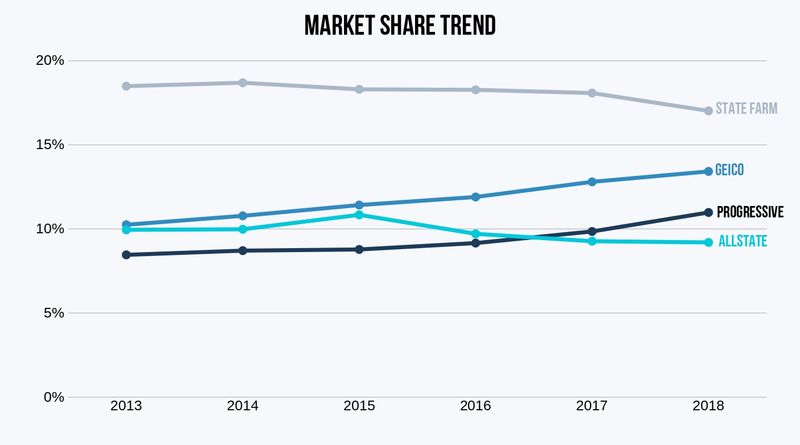
Currently, based on 2018 financials, State Farm is still in the lead in total direct premiums written. Allstate hasn’t lost any of its market shares but continues to trail behind Geico and Progressive in the current five-year growth trend. This chart visually represents the direct premiums written by the four companies over the same five-year period.
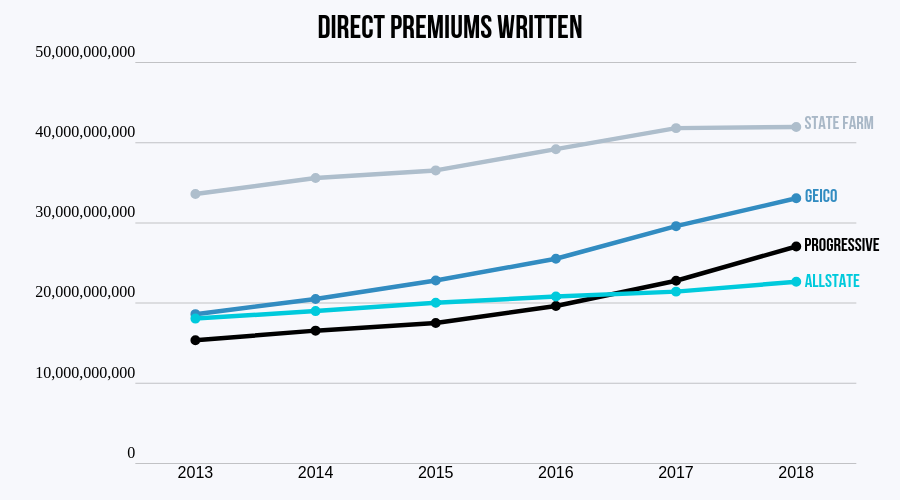
What sets these industry leaders apart from one another? There are a few key differences:
- State Farm is a mutual company owned by its customers, all shouldering risks and rewards equally.
- Geico offers internet-based policies dealing directly with customers, and they also partner with investors.
- Progressive offers both agents and internet-based policies.
- Allstate offers only an agent-based model.
It’s hard to say which business model is the best of the best, but, as the consumer, you have choices. Your individual needs and preferences will ultimately determine the best company for you. Compare the Best Car Insurance Companies by Region
If you plan to move a state or two over, up, or down, these tables may be helpful. Sometimes when moving out of state (even within the same region), your current carrier may not have the best rates.
In some cases, neighboring states have such cheaper car insurance, it may be more feasible to move there and commute to work or ride the subway.
We’ve broken down the 50 states into regions so you can take a quick look at the average rate of your current (or future) insurance provider.
Average Car Insurance Rates by Company in the Midwest
We’ll start with the Midwest. Take a look at this table to see the average annual rates by state.
Top 10 Car Insurance Companies in the Midwest by Rate
| State | | | | | | | | | | |
|---|---|---|---|---|---|---|---|---|---|---|
| Illinois | $434 | $318 | $384 | $232 | $190 | $226 | $295 | $195 | $208 | $231 |
| Indiana | $332 | $307 | $286 | $188 | $482 | $275 | $325 | $201 | $283 | $136 |
| Iowa | $247 | $252 | $203 | $191 | $368 | $228 | $200 | $185 | $452 | $154 |
| Kansas | $334 | $179 | $309 | $268 | $399 | $206 | $345 | $227 | $362 | $199 |
| Michigan | $1,909 | $1,100 | $709 | $536 | $1,667 | $527 | $447 | $1,047 | $731 | $302 |
| Minnesota | $378 | $293 | $261 | $292 | $1,130 | $244 | $350 | $172 | $320 | $238 |
| Missouri | $341 | $274 | $359 | $240 | $377 | $189 | $285 | $224 | $299 | $210 |
| Nebraska | $267 | $185 | $333 | $320 | $520 | $217 | $313 | $203 | $280 | $194 |
| North Dakota | $389 | $318 | $258 | $222 | $1,071 | $213 | $302 | $213 | $348 | $167 |
| Ohio | $266 | $126 | $285 | $156 | $369 | $275 | $286 | $209 | $261 | $123 |
| South Dakota | $394 | $337 | $314 | $245 | $626 | $228 | $313 | $192 | $275 | $185 |
| Wisconsin | $405 | $126 | $315 | $327 | $563 | $435 | $261 | $199 | $325 | $248 |
| U.S. Average | $475 | $247 | $335 | $268 | $647 | $272 | $307 | $272 | $383 | $200 |
Liberty Mutual has the overall highest average rate of $7,762 per year. In the Midwest, Michigan car insurance has the highest rates, where coverage by Allstate tops out at just under $23,000.
Read more: Compare Vermont Car Insurance Rates
Free Insurance Comparison
Compare Quotes From Top Companies and Save
Average Car Insurance Rates by Company in the Northeast
Next, we’ll look at the Northeast. This table outlines average annual rates by state.
Top 10 Car Insurance Companies in the Northeast by Rate
| State | | | | | | | | | |
|---|---|---|---|---|---|---|---|---|---|
| Connecticut | $486 | $346 | $256 | $607 | $306 | $410 | $248 | $500 | $266 |
| Maine | $306 | $231 | $235 | $361 | $250 | $304 | $183 | $188 | $161 |
| Massachusetts | $226 | $210 | $126 | $362 | $280 | $320 | $113 | $295 | $122 |
| New Hampshire | $227 | $191 | $135 | $704 | $208 | $225 | $182 | $256 | $159 |
| New Jersey | $476 | $635 | $230 | $564 | $420 | $331 | $627 | $355 | $300 |
| New York | $395 | $310 | $202 | $545 | $334 | $314 | $374 | $382 | $313 |
| Pennsylvania | $332 | $290 | $217 | $505 | $233 | $371 | $229 | $654 | $149 |
| Rhode Island | $413 | $341 | $467 | $515 | $367 | $436 | $201 | $576 | $360 |
| Vermont | $266 | $211 | $183 | $302 | $177 | $435 | $365 | $210 | $159 |
| U.S. Average | $347 | $433 | $228 | $496 | $271 | $349 | $280 | $421 | $211 |
Read more: Compare New Hampshire Car Insurance Rates
Liberty Mutual has the overall highest rate of $5,952 per year. In the northeast, New Jersey car insurance has the highest rates, where coverage by State Farm leads the way with a yearly rate of $7,527.
Average Car Insurance Rates by Company in the Southeast
This table includes average annual rates for states in the Southeast part of the country.
Top 10 Car Insurance Companies in the Southeast by Rate
| State | | | | | | | | | |
|---|---|---|---|---|---|---|---|---|---|
| Alabama | $225 | $198 | $239 | $212 | $181 | $218 | $155 | $205 | $177 |
| Arkansas | $183 | $198 | $150 | $125 | $125 | $203 | $172 | $120 | $72 |
| Delaware | $326 | $301 | $311 | $410 | $315 | $348 | $372 | $310 | $194 |
| Florida | $260 | $240 | $315 | $290 | $250 | $330 | $283 | $270 | $238 |
| Georgia | $265 | $248 | $248 | $275 | $215 | $250 | $282 | $220 | $263 |
| Kentucky | $310 | $290 | $386 | $315 | $280 | $310 | $280 | $290 | $241 |
| Louisiana | $340 | $330 | $513 | $335 | $310 | $380 | $382 | $360 | $363 |
| Maryland | $285 | $290 | $319 | $310 | $270 | $341 | $330 | $310 | $229 |
| Mississippi | $230 | $220 | $341 | $225 | $210 | $230 | $248 | $220 | $171 |
| North Carolina | $170 | $160 | $245 | $182 | $160 | $199 | $257 | $261 | $200 |
| South Carolina | $190 | $185 | $265 | $210 | $175 | $215 | $256 | $240 | $285 |
| Tennessee | $220 | $210 | $274 | $240 | $225 | $230 | $220 | $228 | $228 |
| Virginia | $175 | $165 | $172 | $160 | $140 | $208 | $189 | $150 | $155 |
| West Virginia | $210 | $190 | $177 | $244 | $215 | $180 | $177 | $180 | $165 |
| U.S. Average | $200 | $198 | $292 | $235 | $220 | $275 | $279 | $250 | $222 |
Again, Liberty Mutual has the highest overall rate of $6,879 per year. In the southeast, Delaware car insurance has the highest rates, where coverage by Liberty Mutual tops out at $18,360.
Average Car Insurance Rates by Company in the Southwest
Take a look at this table for average annual rates for states in the Southwest. Learn more in our “How do you get competitive quotes for car insurance?.”
Top 10 Car Insurance Companies in the Southwest by Rate
| State | | | | | | | | | | |
|---|---|---|---|---|---|---|---|---|---|---|
| Arizona | $4,904 | Data Not Available | $5,000 | $2,265 | Data Not Available | $3,496 | $3,578 | $4,756 | $3,085 | $3,084 |
| New Mexico | $4,201 | Data Not Available | $4,316 | $4,458 | Data Not Available | $3,514 | $3,119 | $2,341 | Data Not Available | $2,297 |
| Oklahoma | $3,719 | Data Not Available | $4,142 | $3,437 | $6,875 | Data Not Available | $4,832 | $2,817 | Data Not Available | $3,174 |
| Texas | $5,485 | $4,849 | Data Not Available | $3,263 | Data Not Available | $3,868 | $4,665 | $2,880 | Data Not Available | $2,488 |
| AVERAGE | $4,577 | $4,849 | $4,486 | $3,356 | $6,875 | $3,626 | $4,048 | $3,198 | $3,085 | $2,761 |
Liberty Mutual has the highest overall rate of $6,874 per year, followed by American Family, whose average rate is $4,849.
Free Insurance Comparison
Compare Quotes From Top Companies and Save
Average Car Insurance Rates by Company in the West
Finally, we’ll look at average annual rates for states in the Western part of the country.
Top 10 Car Insurance Companies in the West by Rate
| State | | | | | | | | | | |
|---|---|---|---|---|---|---|---|---|---|---|
| Alaska | $262 | $346 | $410 | $240 | $441 | $331 | $255 | $186 | $368 | $2,454 |
| California | $378 | $465 | $417 | $240 | $253 | $388 | $237 | $350 | $279 | $2,694 |
| Colorado | $461 | $346 | $441 | $258 | $233 | $312 | $353 | $273 | $390 | $3,339 |
| Hawaii | $181 | $249 | $397 | $280 | $266 | $196 | $213 | $181 | $87 | $1,189 |
| Idaho | $341 | $346 | $264 | $231 | $192 | $253 | $187 | $156 | $269 | $1,878 |
| Montana | $389 | $288 | $326 | $300 | $111 | $290 | $361 | $201 | $415 | $2,032 |
| Nevada | $448 | $346 | $466 | $305 | $517 | $290 | $339 | $483 | $447 | $3,069 |
| Oregon | $397 | $346 | $313 | $268 | $361 | $265 | $302 | $228 | $241 | $2,587 |
| Utah | $297 | $346 | $326 | $247 | $361 | $249 | $319 | $387 | $410 | $2,491 |
| Washington | $295 | $346 | $247 | $214 | $333 | $177 | $267 | $208 | $397 | $2,262 |
| Wyoming | $364 | $298 | $256 | $291 | $166 | $266 | $367 | $192 | $420 | $2,780 |
| U.S. Average | $347 | $346 | $345 | $261 | $294 | $270 | $298 | $250 | $309 | $2,434 |
Allstate has the highest overall rate of $4,161 per year. In the west, Nevada car insurance has the highest rates where coverage from Liberty Mutual leads the way at $6,202.
Compare the Best Car Insurance Companies by State
The state in which you live has a huge influence on your rate. Every state is different, and it usually has a lot to do with the laws. For example, one dividing factor between 11 states and the remaining 39 is whether or not their laws are at-fault-based or no-fault-based.
Typically, no-fault states require drivers to purchase a certain amount of personal injury protection coverage (PIP), which is elective in most at-fault states.
Michigan has just passed historic legislation to overhaul its insurance systems completely. To read more about the insurance laws in your state, be sure and check out our comprehensive state guides linked in the table below.
Car Insurance Guides by State
Next, we’ll discuss insurance companies by rates.
Best Car Insurance Companies by Rates
It’s not just laws that can affect your rates. Many companies offer cheaper options, and some even advertise, “to pick and choose only the coverage you need.” Delve into our evaluation of “Does a negligent driving ticket affect car insurance rates?”
The following sections and tables show national-level rates for the top 10 auto insurance providers based on various demographics.
Free Insurance Comparison
Compare Quotes From Top Companies and Save
Compare the Best Car Insurance Rates by Gender
Some states have outlawed car insurance rates based on gender, and other states now require a non-binary category when drivers obtain a quote. Discover insights in our “Average Car Insurance Rates by Age and Genderr.”
We have removed teenage drivers from this table since their age more heavily influences their rates rather than their gender.
Top 10 Car Insurance Companies: Monthly Rates by Gender
| Insurance Company | Female | Male |
|---|---|---|
| $162 | $160 |
| $115 | $117 |
| $139 | $139 |
| $80 | $80 |
| $171 | $174 |
| $113 | $115 |
| $112 | $105 |
| $86 | $86 |
| $98 | $99 |
| $59 | $59 |
| U.S. Average | $119 | $119 |
The numbers don’t lie: on average, males pay an average of an extra $80 per year for the same coverage as female drivers do.
Compare the Best Car Insurance Rates by Relationship Status
There is a difference in the cost of married car insurance vs. single car insurance.
We have removed teenage drivers from the table below since their age more heavily influences their rates rather than their marital status.
Top 10 Car Insurance Companies: Monthly Rates by Age & Gender
| Age & Gender | | | | | | | | | | |
|---|---|---|---|---|---|---|---|---|---|---|
| 16-Year-Old Female | $448 | $305 | $597 | $220 | $626 | $303 | $591 | $229 | $530 | $180 |
| 16-Year-Old Male | $519 | $414 | $629 | $254 | $626 | $387 | $662 | $284 | $740 | $203 |
| 25-Year-Old Female | $181 | $124 | $172 | $97 | $187 | $136 | $141 | $101 | $107 | $80 |
| 25-Year-Old Male | $190 | $147 | $180 | $93 | $215 | $150 | $146 | $111 | $116 | $85 |
| 35-Year-Old Female | $263 | $263 | $213 | $192 | $317 | $197 | $191 | $173 | $182 | $129 |
| 35-Year-Old Male | $260 | $260 | $213 | $193 | $321 | $199 | $181 | $173 | $183 | $128 |
| 60-Year-Old Female | $150 | $104 | $120 | $73 | $148 | $99 | $92 | $76 | $148 | $53 |
| 60-Year-Old Male | $154 | $105 | $128 | $74 | $159 | $104 | $95 | $76 | $159 | $53 |
Female drivers pay more for car insurance, based on this data. Not all companies provide a discount for marital status, while Geico and State Farm have similar rates.
Compare the Best Car Insurance Rates for New Drivers
Teen car insurance is often expensive. Take a look at this table to see the average rates for teenagers and young adults.
Top 10 Car Insurance Companies: Monthly Rates for Teens and Young Adults
| Insurance Company | 17-Year-Old Female | 17-Year-Old Male | 24-Year-Old Female | 24-Year-Old Male |
|---|---|---|---|---|
| $448 | $519 | $181 | $190 |
| $305 | $414 | $124 | $147 |
| $597 | $629 | $172 | $180 |
| $220 | $254 | $97 | $93 |
| $626 | $626 | $187 | $215 |
| $303 | $387 | $136 | $150 |
| $591 | $662 | $141 | $146 |
| $229 | $284 | $101 | $111 |
| $530 | $740 | $107 | $116 |
| $180 | $203 | $80 | $85 |
| U.S. Average | $403 | $472 | $133 | $143 |
If you have teen drivers in your household, Geico offers the least expensive coverage at $5,966 per year. Liberty Mutual charges nearly double that rate, so if the cost is a major deal-breaker, then they may not be the best choice.
Free Insurance Comparison
Compare Quotes From Top Companies and Save
Compare the Best Car Insurance Rates for Adults Ages 20 to 30
This table provides data on average rates for drivers in their 20s and 30s by company. See more details on our “Compare Texas Car Insurance Rates.”
Top 10 Car Insurance Companies: Monthly Rates for Drivers in Their 20s and 30s
| Insurance Company | 25-Year-Old Female | 25-Year-Old Male | 34-Year-Old Female | 34-Year-Old Male |
|---|---|---|---|---|
| $181 | $190 | $161 | $170 |
| $124 | $147 | $111 | $129 |
| $172 | $180 | $152 | $159 |
| $97 | $93 | $85 | $82 |
| $187 | $215 | $166 | $190 |
| $136 | $150 | $118 | $127 |
| $141 | $146 | $124 | $129 |
| $101 | $111 | $89 | $98 |
| $107 | $116 | $95 | $103 |
| $80 | $85 | $71 | $76 |
| U.S. Average | $133 | $143 | $117 | $113 |
Nationally, Geico, Travelers, and USAA (military-affiliated only) charge the least for covering single drivers in their mid-20s to mid-30s. Liberty Mutual has the highest rates at $4,231 per year.
Compare the Best Car Insurance Rates for Adults Ages 40 to 50
In this table, we outline the average annual rates for drivers between their mid-30s and mid-50s by company. Take a look.
Top 10 Car Insurance Companies: Monthly Rates for Drivers in Their 40s and 50s
| Insurance Company | 45-Year-Old Female | 45-Year-Old Male | 59-Year-Old Female | 59-Year-Old Male |
|---|---|---|---|---|
| $162 | $160 | $150 | $154 |
| $115 | $117 | $104 | $105 |
| $139 | $139 | $120 | $128 |
| $80 | $80 | $73 | $74 |
| $171 | $174 | $148 | $159 |
| $113 | $115 | $99 | $104 |
| $112 | $105 | $92 | $95 |
| $86 | $86 | $76 | $76 |
| $98 | $99 | $89 | $90 |
| $59 | $59 | $53 | $53 |
| U.S. Average | $114 | $113 | $100 | $104 |
Liberty Mutual charges more than $1,400 more than average for married drivers in this age range.
More information is available about this provider in our “Understanding Your Car Insurance Policy.”
Compare the Best Car Insurance Rates by Adults in Their 60s
Take a look at this table for average annual rates for drivers in their 60s by company. Check out insurance savings in our complete “Car Insurance Policyholder: Explained Simply.”
Top 10 Car Insurance Companies: Monthly Rates for Drivers in their 60s
| Insurance Company | 65-Year-Old Female | 65-Year-Old Male |
|---|---|---|
| $158 | $157 |
| $113 | $114 |
| $136 | $136 |
| $78 | $77 |
| $167 | $170 |
| $111 | $112 |
| $109 | $103 |
| $84 | $83 |
| $96 | $97 |
| $58 | $57 |
| U.S. Average | $111 | $110 |
Nationally, American Family and State Farm charge the least for covering drivers 60 and older.
Free Insurance Comparison
Compare Quotes From Top Companies and Save
Compare the Best Car Insurance Rates by Vehicle Type
Different vehicle types can mean differing insurance rates. Take a look at this table to see what we mean.
Top 10 Car Insurance Companies: Monthly Rates by Vehicle Type
| Insurance Company | Used Sedan | New Sedan | Used SUV | New SUV | Used Truck | New Truck |
|---|---|---|---|---|---|---|
| $396 | $448 | $360 | $412 | $369 | $458 |
| $265 | $310 | $277 | $291 | $287 | $291 |
| $367 | $398 | $311 | $314 | $341 | $366 |
| $258 | $278 | $258 | $278 | $258 | $278 |
| $489 | $557 | $485 | $520 | $486 | $499 |
| $296 | $280 | $293 | $277 | $298 | $281 |
| $369 | $377 | $304 | $311 | $326 | $330 |
| $252 | $266 | $269 | $285 | $267 | $291 |
| $368 | $388 | $365 | $392 | $335 | $368 |
| $201 | $202 | $205 | $211 | $213 | $238 |
| U.S. Average | $326 | $351 | $313 | $329 | $318 | $340 |
In all cases, a new sedan will cost you more for car insurance than a used model. The same goes for SUVs, except for Nationwide, which charges less for a used model. One could expect to pay higher premiums for their older or antique car insurance.
Compare the Best Car Insurance Rates by Credit Score
Who has the best rates for car insurance based on credit score? If you’re below 600, then companies may want you to pay more.
Check out the table below to see where your number lands for good, fair, and bad credit.
Top 10 Car Insurance Companies: Monthly Rates by Credit Score
| Insurance Company | Good Credit | Fair Credit | Poor Credit |
|---|---|---|---|
| $110 | $130 | $150 |
| $105 | $125 | $145 |
| $115 | $135 | $155 |
| $95 | $115 | $135 |
| $100 | $120 | $140 |
| $102 | $122 | $142 |
| $98 | $118 | $138 |
| $90 | $110 | $130 |
| $112 | $132 | $152 |
| $85 | $105 | $125 |
| U.S. Average | $101 | $121 | $141 |
Liberty Mutual charges more than double for car insurance for customers who have poor credit versus those with good credit. Read more: Compare Taxi Cab Insurance Rates
Compare the Best Car Insurance Rates by Driving History
If there’s one factor that insurance companies can use in determining rates that is non-discriminatory, it’s your driving record. Car insurance with a bad driving record will cost more. Finding the best car insurance companies after an accident requires a little more work, but it can be done.
The table below shows how much your rates can go up with just one speeding ticket, as well as rates for several other infractions.
Top 10 Car Insurance Companies: Monthly Rates by Driving Record
| Insurance Company | Clean Record | One Ticket | One Accident | One DUI |
|---|---|---|---|---|
| 160 | 188 | 225 | 270 |
| 117 | 136 | 176 | 194 |
| 139 | 173 | 198 | 193 |
| 80 | 106 | 132 | 216 |
| 174 | 212 | 234 | 313 |
| 115 | 137 | 161 | 237 |
| 105 | 140 | 186 | 140 |
| 86 | 96 | 102 | 112 |
| 99 | 134 | 139 | 206 |
| 59 | 67 | 78 | 108 |
| U.S. Average | $113 | $139 | $163 | $199 |
Read more:
- Geico Defensive Driving Course Review: Compare Rates, Discounts, & Requirements
- Geico DriveEasy Review: Compare Rates, Discounts, & Requirements
Speed trap? Not only will you have to pay for the ticket, but there’s a good chance you’re trapped into paying more for your insurance. Progressive charges over $600 more for drivers who have a speeding ticket than those with a clean record.
More difficult to find are the best car insurance companies after a DUI. Some car insurance companies won’t work with you after a DUI conviction, and you’ll definitely see higher rates. However, it’s integral to compare rates after a DUI, or you’ll likely overpay for your coverage.
Free Insurance Comparison
Compare Quotes From Top Companies and Save
Compare the Best Car Insurance Rates by Commute
In the case of commute distance, a shorter commute is considered 10 miles or 6,000 miles per year. A long commute is considered 25 miles or 12,000 miles per year.
Top 10 Car Insurance Companies: Monthly Rates by Annual Mileage
| Insurance Company | 6,000 Miles | 12,000 Miles |
|---|---|---|
| $403 | $411 |
| $283 | $290 |
| $348 | $351 |
| $264 | $272 |
| $500 | $513 |
| $286 | $289 |
| $336 | $337 |
| $265 | $279 |
| $367 | $372 |
| $207 | $216 |
| U.S. Average | $326 | $333 |
Rates are consistent with the top 10 companies, as there is less than a $200 difference between a short and long commute.
Discover more about offerings in our “Car Insurance Terms & Definitions.”
The Best Company for Car Insurance
The best company for auto insurance depends on individual needs. Companies like USAA, State Farm, and Geico have the lowest average rates at an average of $230.41/mo, but may not be the best company for auto insurance for you.
- Before purchasing auto insurance, you must clearly define your insurance needs
- You must realize there are numerous insurance discounts available to you
- Do your research by reading reviews about the various insurance companies you are considering
- Use internet quote tools to ensure you are buying the best deal for your unique situation
When shopping for auto insurance, it’s natural to ask what is the best car insurance company. However, the answer will be different depending on a number of factors.
On one hand, you have the car insurance companies that dominate national market shares such as Geico, Allstate, State Farm, and Nationwide, but on the other hand, you have many highly rated companies that have smaller footprints or offer specialized types of coverage.
There really is no single best company for every driver. Keep reading to learn more.
Enter your ZIP code into our free comparison tool to start your search for car insurance.
Figuring Out Your Insurance Needs
If you don’t understand what types of car insurance you need, how can you choose the best policy option? Learn about auto insurance and build a good base knowledge of the coverage you need before starting any search.
Most car insurance companies will ask for the same information, so make a list that’s easy to read and keep it handy.
Providing the same information to each potential car insurance company will make sure you are comparing apples-to-apples, as the quotes received will all be based on the same information.
Some of the most important details to have are:
- Names and number of household drivers
- Type of vehicle and VIN number
- List of vehicle safety features
- Estimated annual usage
Keep reading to learn more about car insurance discounts and other factors to consider when shopping for insurance.
Free Insurance Comparison
Compare Quotes From Top Companies and Save
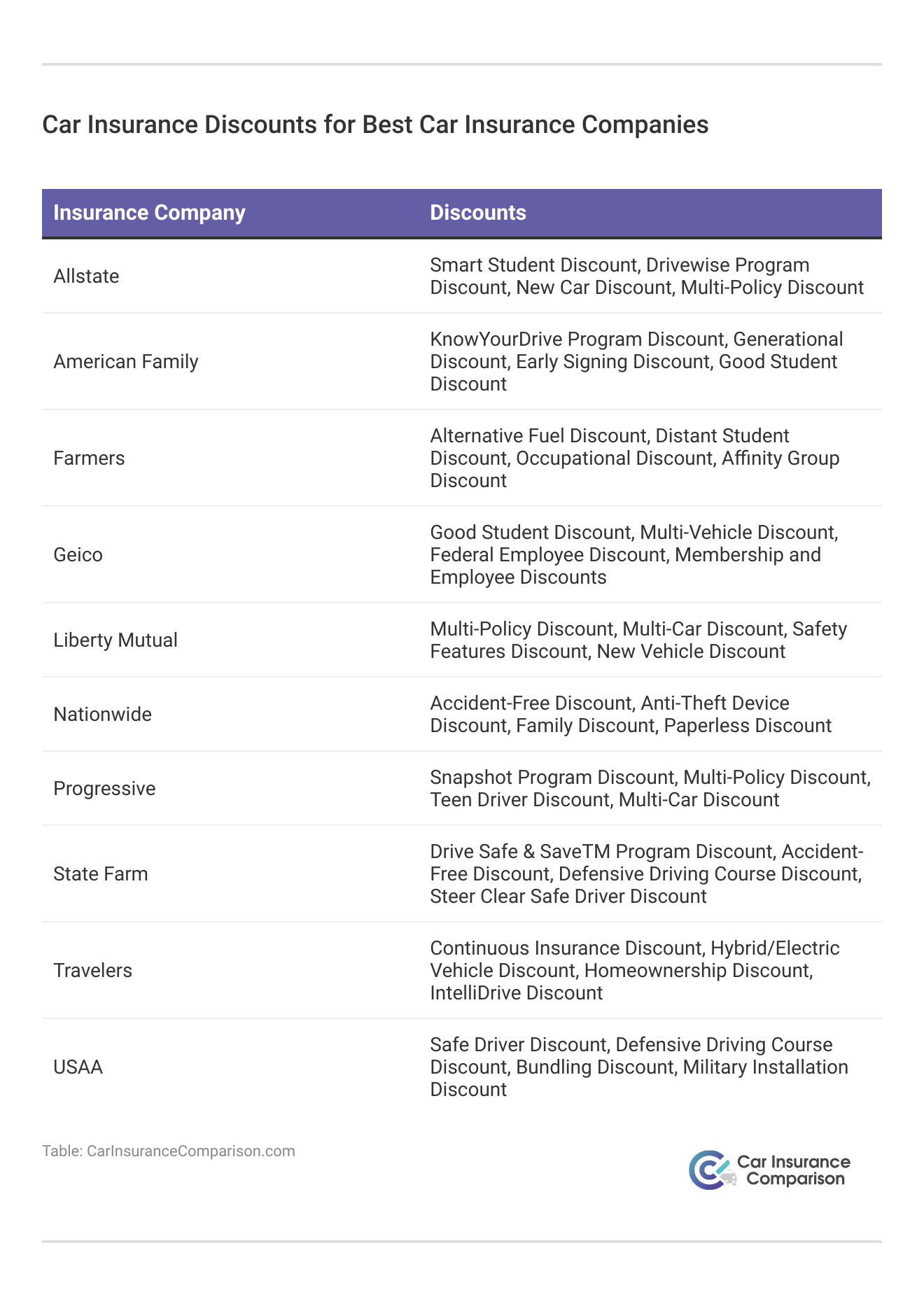
Finding Car Insurance Discounts
This is very important since a lot of drivers assume they will receive lots of discounts by answering questions. But what if the agency representative does not ask all the right questions?
Learn what common car insurance discounts are available and make sure to ask any potential car insurance company about your eligibility.
From multi-vehicle discounts to good grades discounts for young drivers, a wide variety of discounts are available, and ultimately it is up to you to ask for them.
Compare the Best Car Insurance Companies by Customer Reviews
Car insurance reviews should be researched based on the experiences of people who have filed a claim.
Customer service is a big aspect of auto insurance, and you want to hear from people who have filed a claim, as the real test of an auto insurance company is when you have to ask them for money.
Anyone can write a check for rates, and most customer service representatives are pretty friendly; however, when it comes to using the coverage you have paid for, it’s important to know that the claims handling team is as cooperative as the division cashing your checks.
You may also want to look at industry rating agencies like A.M. Best, Standard & Poor’s, and J.D. Powers and Associates for financial and customer service ratings.
State Farm offers unmatched value with their competitively priced full coverage options.
Tracey L. Wells Licensed Insurance Agent & Agency Owner
As we noted earlier these three agencies handle most of the awards and financial stability ratings in the auto insurance industry.
While very few of the big car insurance companies ever get a failing grade, and sometimes ratings can be a little difficult to interpret, it is still worth factoring this information into your decision process.
Readmore: Assurant Car Insurance Review
Why You Should Compare Rates
Your search for car insurance started out as a car insurance comparison search, so never take the first quote or accept a policy until you really have compared enough companies to make a qualified decision.
The best auto insurance company for you doesn’t have to be the winner of an award, just a reliable company with whom you feel comfortable. This can certainly vary depending on who you speak with.
Access comprehensive insights into our “Best Car Insurance for Married Couples on Separate Policies.”
Be sure to compare rates using our free search tool below.
Free Insurance Comparison
Compare Quotes From Top Companies and Save
Top-Rates Car Insurance Companies
Choosing a car insurance carrier is one of the most important insurance decisions you will ever have to make.
Larger insurance companies have a number of advantages over smaller ones. Large companies are financially stable and able to continue providing coverage through periods of economic boom and bust. Financial stability also means larger insurers are generally more reliable than smaller ones
If you listen to the advertisements, every car insurance company in the country would have you believe they offer the lowest rates and the best customer service. While all companies have strengths and weaknesses, some do have more of a claim on the top spot than others.
By taking a look at the largest insurance companies and those with the best customer service, we can try and determine the top insurance company in the country. Delve into our evaluation of “Can I transfer car insurance to another person?.”
Enter your ZIP code into our free tool, and we will help you find the best car insurance for your needs by sending multiple car insurance quotes for free.
Compare the Best Car Insurance Companies by Size
Larger insurance companies have a number of advantages over smaller ones. Large companies are financially stable and able to continue providing coverage through periods of economic boom and bust.
Their large financial base also means they’re not going to suddenly change their premiums to make up for a financial shortfall.
Financial stability also means larger insurers are generally more reliable than smaller ones. Smaller insurance companies are also more likely to be bought and sold.
Large companies grew from small companies by offering what customers want. They offer reliability and stability and have developed the trust you need in your insurance provider. Unlock details in our “Should you shop around for car insurance?.”
Car Insurance Prices by Company Size
Many large companies are better able to compete on price as well. Although some small insurers try and undercut industry giants, they may raise their rates more quickly because their initial rate is unsustainable.
They may also struggle to offer the same level of responsiveness for claims and policy services because they have fewer resources with which to act.
The Largest Car Insurance Companies
So who are the largest insurance companies? The five largest insurance companies by market share in are listed below:
- State Farm: 16%
- Geico: 4%
- Progressive: 12%
- Allstate: 9%
- USAA: 6%
State Farm has been the largest insurance company for a long time, although it has lost market share to discount providers like Esurance.
However, once we look at the customer service scores, you’ll see why State Farm has maintained its position, despite losing a little bit of market share. Discover insights in our “Will car insurance companies price match?.”
Free Insurance Comparison
Compare Quotes From Top Companies and Save
Why Customer Service is Important
When you buy insurance, it’s tempting to skimp on customer service. Car insurance customer service is very important, even though your insurance company is not a company you hope to interact with very often.
However, when you need your insurance company, you really need everything to go smoothly. An accident is expensive enough without your insurance company skimping on coverage or directing you to a disreputable body shop with low rates.
Read More: Compare Best Car Insurance Companies That Beat Quotes
Finding the Car Insurance Company With the Best Customer Service
Companies with good customer service scores generally provide their customers with plenty of options and an easy buying experience. Many have individual agents rather than an online-based policy buying system.
These agents build relationships with customers and help explain what each type of coverage means and why a policyholder may need it.
Companies without agents, where customers buy entirely online, have struggled to match the customer service scores of those with agents.
A customer may eliminate coverage for something they really need while shopping online, not realizing they’ve done so until they have an accident.
Some insurers also offer lower default coverage limits, so a particularly nasty accident may exceed what the insurance company has agreed to pay. Learn more in our “Compare Comprehensive Car Insurance: Rates, Discounts, & Requirements.”
Car Insurance Companies With the Best Customer Service
Amica, a company that doesn’t even crack the top 10 of the largest insurance companies, received J.D. Power and Associates award for the highest customer satisfaction scores.
They had a top rating of “among the best” in all five of the ranked categories—overall satisfaction, policy offerings, pricing, billing, payment, and contacting the insurer. Learn how you can get Amica Mutual car insurance quotes here.
Free Insurance Comparison
Compare Quotes From Top Companies and Save
Smaller Companies and Customer Service
Several smaller companies didn’t do as well. Esurance, the discount insurer with the catchy commercials, scored poorly, as did 21st Century, another heavily discounted provider.
These two were the lowest, although several other discount providers also received low scores.
The only other company to do as well as Amica was USAA. However, USAA insurance is only open to military members and their families, and J.D. Power and Associates doesn’t rank companies with restrictions on membership.
Read more:
- Amica vs. AAA Car Insurance Comparison
- 21st Century vs. Amica Car Insurance Comparison
- Allstate vs. Amica Car Insurance Comparison
- American Family vs. Amica Car Insurance Comparison
- Progressive vs. USAA Car Insurance Comparison
- Allstate vs. Nationwide Car Insurance Comparison
The Best Large Car Insurance Company
The best of the large insurance companies is State Farm. It received high scores in overall customer satisfaction and how easy they are to contact.
They also had above-average marks in the rest of the categories including policy offerings, pricing, billing, and payment. Their network of agents provides a lot of support to their customers and a level of one-on-one service other companies struggle to match, which is only one of the benefits of choosing State Farm.
The Top Insurance Company
By combining the largest insurance companies and their J.D. Power scores, it’s clear State Farm has scored well on customer service as well as being the largest insurance provider in the country.
The other large insurance companies had good customer service scores as well, so they’re all more or less in second place, just below State Farm
However, since all these insurance companies price things differently, you should make sure you shop around frequently to make sure you’re still getting the best price on your car insurance.
The best way to shop around for car insurance for free is to enter your ZIP code in our car insurance comparison tool.
Free Insurance Comparison
Compare Quotes From Top Companies and Save
More on Car Insurance Companies and Customer Service
Finding the cheapest car insurance for you can be done by (1) visiting third-party review sites, (2) looking at financial ratings, and (3) comparing quotes from multiple companies.
- The best car insurance company will depend on personal factors
- Finding the best car insurance company for you takes research
- Customer service and financial stability are important factors when choosing a provider
Everyone has his or her own preference, which is not likely to change unless there’s a major reason to do so.
The fact is, car insurance is a very personal thing for most people.
It’s not uncommon for an individual driver to stick with the same car insurance company throughout their entire life, especially if they’ve never had any difficulties with it.
You can see online car insurance rates right now by entering your ZIP code in our free tool.
What to Look for in a Car Insurance Company
As we noted earlier, determining who is the best insurance provider requires a serious evaluation of your needs and desires.
For example, every insurance provider licensed to do business in your state will provide the legally required minimum coverage at a price comparable to their competitors.
But you must ask yourself whether or not you require more coverage than simply the state minimums. If you do, you’ll find that’s where most of the price differences begin to show up.
In terms of coverage, you should be looking for a company that will cover your needs at a price you can afford. See more details on our “Best Full Coverage Car Insurance.”
What to Look for in Customer Service
Next to coverage and the bottom-line price, one of the other important factors to consider is customer service, as we’ve already discussed.
Hopefully, you never need to make a car insurance claim, but if you do, customer service turns out to be everything.
The last thing you need during the stress of an accident is to call your insurance company and be put on hold for an hour.
Look for a company that is responsive to your needs not only in a timely manner, but also with a friendly, courteous, and caring attitude.
A good place to investigate customer service is through online car insurance ratings sites such as Moody’s or Weiss Ratings as well as J.D. Power (which we’ve already spent some time discussing) and more.
Many of these sites rate companies according to several criteria, including customer satisfaction. More information is available about this provider in our “How do customer satisfaction ratings affect car insurance companies?.”
Just be careful of comparison websites that glean their information from user forums or other similar resources.
Free Insurance Comparison
Compare Quotes From Top Companies and Save
What to Look for in Financial Stability
In most cases, the financial stability of an insurance company won’t come into play. However, that’s not to say it’s never a factor.
There are some insurance companies that are financially unstable and may present a problem down the road.
The quickest and easiest way to find out where your insurance company stands is to visit the websites of some of the leading financial services rating companies.
Two examples of these types of companies are A.M. Best and Standard & Poor’s.
These companies rate the financial strength and future outlook of insurance companies, banks, and other financial institutions, based solely on hard numbers and forecasts by financial experts. Check out insurance savings in our complete “How much does bankruptcy affect car insurance rates?.”
Everything Else You Should Know About Car Insurance
At the end of the day, whether you’re looking at the top 50 car insurance companies or the top 5 car insurance companies, the best insurance companies are the ones who can provide you with the appropriate coverage, customer satisfaction, and future stability you need.
Finding these companies requires that you do your homework before making a decision.
So ask friends and family, search online, and find out as much information as you can. Doing so will increase your chances of finding the right car insurance company for you.
Get car insurance quotes from America’s best auto insurance companies by entering your ZIP code right now.
The Major Car Insurance Companies
When you’re looking at top-rated auto insurance companies, it’s a good idea to learn more about the major car insurance companies. Some of the factors to consider include:
- A company’s market share, which is the measure of how much of the total market a single company holds
- A smart driver will always compare quotes to find the best insurance deal for his needs
Most of the major car insurance companies appear on the Fortune 500 list, but an appearance on the Fortune 500 alone is sufficient only for identifying large companies (small car insurance companies don’t typically show up on the list).
That list is not useful for ranking car insurance companies in the order of the major car insurers.
Therefore, the car insurance companies identified here as the major companies serving the broader national market are identified and ranked according to market share.
Enter your ZIP code in our car insurance comparison tool to get free auto insurance quotes.
Free Insurance Comparison
Compare Quotes From Top Companies and Save
Market Share of the Largest Car Insurance Companies
In 2010, State Farm’s national market share was 18, meaning that it writes 18% of all of the car insurance policies written across the entire country.
Ranking companies by market share means State Farm is at the top of the list.
The top ten best car insurance companies in terms of market share wrote 68% of all of the car insurance policies across the country.
Companies near the end of the list that have a market share of around only two percent still write plenty of car insurance policies.
As an example, at the beginning of 2011, there were 254,212,610 registered highway vehicles in the United States. A two percent share of that huge market equates to more than five million policies.
A car insurance company with only a two percent share of the market is still a large company. Keep reading to learn more about the 10 largest insurance companies in the country. Discover more about offerings in our “The Best Car Insurance Commercials.”
#1 – State Farm Insurance
State Farm is the leader in the U.S. market, with a market share of 16%. Revenues decreased from $81.7 billion in 2018 to $79.4 billion in 2019.
State Farm provides many benefits when a consumer chooses them for auto insurance.
Although the biggest player in the auto insurance arena, State Farm will still take on car insurance for high-risk drivers with less-than-perfect driving records.
In an auto claims satisfaction study by J.D. Power, State Farm ranked sixth compared to many of the other large insurance providers. This insurer ranks higher marks for its insurance claims process and customer service. State Farm has a local insurance agent in almost every city, so you receive more personalized attention than you do with Amica.
The NAIC analyzed the complaints filed with state insurance regulators and concluded that State Farm was at fault for denying claims unfairly at a rate far lower than the average insurance company.
Check out this more detailed State Farm car insurance review.
Read More: Traits of the Worst Car Insurance Companies
#2 – Geico
The second-largest car insurance company in terms of market share, Geico, has been a part of Warren Buffett’s Berkshire Hathaway company for several years.
Revenues in 2019 to $35.57 billion from $33.63 billion in 2018.
Check out our Geico car insurance review for more information.
Free Insurance Comparison
Compare Quotes From Top Companies and Save
#3 – Progressive
Progressive’s revenues increased from $31.98 billion in 2018 to $39 billion in 2019.
Much of that increase may be attributed in part to Progressive’s extensive advertising.
If you want more information, look into our Progressive car insurance review.
#4 – Allstate
In second place with a 10% share of the market, Allstate is actually larger than State Farm in terms of total revenue. Its revenues in 2018 were $39.82 billion, which increased in 2019 to $44.68 billion.
The difference in revenues between the top two companies reflects the numbers of policies sold, not any price differences in policies.
Check out our Allstate car insurance review if you want to learn more.
#5 – USAA
USAA’s revenues totaled $31.4 billion in 2009, with an increase to $35.6 billion in 2019.
Those who are in the armed services should without a doubt look into the United Services Automobile Association or USAA. The clients of USAA are delighted with the pricing, claims, customer service, and car insurance discounts for military members provided by this carrier.
J.D. Power and Associates rank them very high in these areas as well. The company is very strong financially, scoring the highest levels in the following five independent financial rating services:
- Fitch Ratings
- Moody’s
- A.M. Best
- Standard & Poor’s
- Weiss
Their complaints are equal to or better than the average auto insurance provider as well.
Take a look at our USAA car insurance review to learn more.
Free Insurance Comparison
Compare Quotes From Top Companies and Save
#6 – Liberty Mutual
One of the oldest car insurance companies, Liberty Mutual was founded in 1912.
It collected revenues of $41.57 billion in 2018 but increased total revenues to $43.2 billion in 2019.
You can learn more about this company by reading our Liberty Mutual car insurance review.
#7 – Farmers
Founded in 1928, Farmers Insurance Group is an old company. Farmers increased its total revenues to $19.91 billion in 2019.
See our Farmers car insurance review for more detailed information.
#8 – Nationwide
Nationwide is one of the smaller car insurance companies in terms of revenue, despite being founded in 1926.
Nationwide also has been advertising extensively over the past few years, and they have a market share of 2%.
See what Nationwide car insurance discount programs are offered.
Free Insurance Comparison
Compare Quotes From Top Companies and Save
#9 – American Family
American Family Insurance, founded in 1927, increased its revenues from $10.2 billion in 2018 to $12.2 billion in 2019. As one of the United States’ top ten biggest car insurance companies, American Family holds its own in regard to customer reviews and complaints.
In regards to customer complaints, the BBB gives it a very high mark of A+ for handling these issues in a fair, prompt, and above-board manner. Individuals in higher tax brackets seem to think highly of American Family insurance and rate the company well year after year.
According to J.D. Power and Associates, the company does an excellent job of handling claims expeditiously and paying out quickly.
It is a financially strong and stable company and ranks above the national average in regards to not being at fault in regards to customer complaints put before them.
See our American Family car insurance review to learn more.
Each car insurance company has its own personality and pursues different types of drivers. Every driver should compare quotes from several companies to find the lowest price for what fits their own situation.
#10 – Travelers
The Travelers Insurance Company that exists today is one that was founded in 1853.
However, its revenues increased 4% between 2018 and 2019.
Read more details on this company on our Travelers car insurance review page.
How Car Insurance Company Reviews Help You
When you’re shopping for an insurance company, whether you’re considering one of the big ten or looking specifically for the best car insurance in Washington, reviews of the companies are a good way to do some research. Some considerations when looking at reviews include:
- Insurance rating companies’ websites are a great source for accurate reviews
- Reviews can span from being objective to highly emotional, so be discerning
- A good review vs. a bad review makes all the difference for the auto insurance company and how it is viewed by its customers
Since there are so many insurance companies in the industry, you may benefit from reading major car insurance company reviews. These reviews are written to inform you of the many aspects of this arena. This is a way to go beyond quote comparisons and look at the total insurance company for comparisons.
Read more: Compare Washington DC Car Insurance Rates
This is important since you are required to carry car insurance on your vehicle in most states in the U.S. Major car insurance company reviews include information that will educate you on choosing a good and reputable company.
Some people may suggest a friend or family member’s recommendation. Although this type of recommendation is a good suggestion, provided this referral is in the same state, sometimes you may not receive the service you expected.
People usually have the best intentions when they offer you a referral of any kind. If they had a good experience, they want you to have the same experience.
Unfortunately, these good intentions sometimes backfire, and you may end up having a totally different experience from that of your friend or family member.
Find reviews and start comparison shopping today by entering your ZIP code in our free online tool.
Free Insurance Comparison
Compare Quotes From Top Companies and Save
Information in Car Insurance Reviews
When you are in the market for car insurance, your needs may be very different from somebody else’s needs. Your family makeup and all the other categories that factor into a car insurance rate may be entirely different.
Major car insurance reviews usually contain the lines of insurance that the company offers, whether it is a large, medium, or small company, and the average capital the company earns. Unlock details in our “Cheap Car Insurance Companies That Beat Quotes.”
These reviews also contain the company’s rating with the most reputable insurance rating companies in the industry such as:
- A.M. Best
- Standard and Poor’s
- Moody’s
Recall that we’ve noted these companies as good options in previous sections. Company ratings are typically noted in grade form.
For example, most major car insurance companies have an “A++” or similar rating if they are solvent.
A company’s solvency is indicative of its financial strength and ability to pay its policyholders’ claims. If the company’s future business projection does not look promising, the rating companies will give it a lower grade and offer an explanation. A company’s grade also indicates whether or not it has a good standing in the community it serves.
Major car insurance reviews usually inform you of the types of plans they offer. The review will mention the required types of coverage for the states in which the company serves. If the company offers coverage for vehicles such as motorcycles or boats, the review may mention that as well.
The majority of major car insurance reviews are written by policyholders and persons involved in an accident with a policyholder. These reviews are of most interest to the average consumer because they want to know the kind of service the average person receives from the company.
Reviews written by insurance writers are more objective, and these are the ones that contain the most information about the company. If the writer is objective, they may even include information about court cases that involve major car insurance companies.
If the company demonstrates a pattern of unethical practices and claims denials, its actions are usually made manifest in lawsuits, which are matters of public record.
Benefits of Car Insurance Reviews
Major car insurance company reviews are beneficial to the insurance industry because they make big corporations accountable to the public. There was a time, before the Internet when these practices went unnoticed for a longer period of time before they were made public.
It also helps the consumer make educated decisions about who they may consider doing business with.
Reviews are also beneficial to the insurance companies, especially those who have good intentions, and proof of it is expressed in customer and insurance writer reviews.
There are no derogatory cases settled or pending that involve ethical companies. If there was a lesson to be learned, the company learned its lesson and is proving it by keeping its business out of the justice system. Unlock details in our “Where to Find Car Insurance Company Reviews.”
Disadvantages of Car Insurance Company Reviews
For the most part, the disadvantages of major car insurance company reviews fall on the insurance company. If there are too many consistently negative customer and insurance writer reviews, the company stands to lose business.
Bad reviews are a fair disadvantage if the company is guilty of faulty practices. There may be a couple of isolated incidents when a consumer or person involved in a serious car accident may post angry words online. However, a rational person can judge when someone is angry and emotional in a post.
Ultimately, major car insurance company reviews carry no disadvantage to the consumer, who should have the advantage when it comes to spending their hard-earned money. Access comprehensive insights into our “Pros and Cons of Cheap Car Insurance Companies.”
Free Insurance Comparison
Compare Quotes From Top Companies and Save
Compare the Best Car Insurance Companies Today
Now that you have all of this information on the top 10 car insurance companies, are you ready to go your separate ways with your insurance provider?
Remember when you’re shopping for a new insurance company, you should compare rates, look at company ratings for both customer satisfaction and financial stability, and company reviews.
Remember, where you live is the most significant factor in determining what your car insurance rates will be. Delve into our evaluation of “Car Insurance Discounts: Compare the Best Discounts.”
Before you go, use your ZIP code to get a free quote so you can start comparing rates today to make sure you get coverage from the best insurance company for your needs.
Frequently Asked Questions
How do I choose the best car insurance company?
Choosing the best car insurance company involves considering several factors such as coverage options, customer service, claims handling, financial stability, and affordability. You can compare the offerings of different insurance companies, read customer reviews, and evaluate their reputation and track record to make an informed decision.
What are the top car insurance companies?
The top car insurance companies may vary depending on individual needs and preferences. However, some well-known and highly regarded insurance providers include State Farm, Geico, Progressive, Allstate, USAA (for military members and their families), and Liberty Mutual.
What are the pros of choosing a reputable car insurance company?
Pros of choosing a reputable car insurance company include:
- Reliable customer service and claims handling.
- Comprehensive coverage options tailored to your needs.
- Financial stability, ensuring the company’s ability to pay claims.
- Strong track record and reputation in the industry.
- Access to additional benefits and discounts.
- Convenient online tools and mobile apps for managing your policy.
What are the cons of choosing a reputable car insurance company?
Cons of choosing a reputable car insurance company may include:
- Potentially higher premiums compared to smaller or less established insurers.
- Limited flexibility in customizing your policy.
- Some additional features or perks may come at an extra cost.
- Certain discounts or coverage options may not be available with all reputable companies.
How can I find the top car insurance companies in my area?
To find the top car insurance companies in your area, you can start by conducting online research, reading customer reviews and ratings, comparing coverage options and prices, and consulting with local insurance agents or brokers who can provide personalized recommendations.
To find out more, explore our guide titled “The Top 5 Car Insurance Companies.”
What are the top 10 cheapest car insurance companies?
The top 10 cheapest car insurance companies vary by region and driver profile, but typically include providers known for low rates and discounts.
Who are the 10 best auto insurance companies?
The 10 best auto insurance companies are those highly rated for customer service, coverage options, and financial stability. The list can change annually based on new data.
Where can I find auto insurance best reviews?
Auto insurance best reviews can be found on consumer websites, insurance comparison sites, and financial industry watchdogs that evaluate and rate insurance companies.
Which company offers the best auto insurance in Virginia?
The best auto insurance in Virginia depends on your specific needs, but look for companies with strong local reviews and competitive pricing.
To learn more, explore our comprehensive resource on “Erie Car Insurance Review.”
How do I choose the best car insurance in Florida?
To choose the best car insurance in Florida, compare rates and policies from multiple providers and consider factors like coverage options, customer service ratings, and claims satisfaction.
What do the latest farmers insurance reviews say?
Geico vs Hartford car insurance: which is better?
Are there other insurance companies like Geico?
What should I know about National General Insurance?
What is Otto Insurance?
What type of insurance is most important for cars?
What is the best least expensive car insurance?
Which is the biggest insurance company in Asia?
What is the popular type of insurance?
What age is car insurance most expensive?
Related Articles
-
Jan 2025

Best Temporary Car Insurance in 2026 (Your Guide to the Top 10 Providers)
-
Oct 2024
Best Car Insurance for Children of Divorced Parents in 2026 (Top 10 Companies Ranked)
-
Feb 2025
Best Car Insurance for Married Couples on Separate Policies in 2026 (Top 10 Providers)
-
Jun 2024
Best Car Insurance for Low-Income Drivers in 2026 (Top 10 Companies Ranked)
-
Jul 2024
Best Car Insurance for a Restricted License in 2026 (Top 10 Companies)
-
Feb 2025
Best Car Insurance for Inexperienced Drivers in 2026 (Top 10 Companies)
Get a FREE Quote in Minutes
Insurance rates change constantly — we help you stay ahead by making it easy to compare top options and save.