

How far back do car insurance companies look?
How car back do car insurance companies, like Geico, look at your driving record? To secure affordable car insurance, compare companies and shop around to find the best rates.






Table of Contents
Table of Contents

Insurance and Finance Writer
Dorothea Hudson has been professionally writing in many spheres since 2013. She has written on entertainment, insurance, finance, travel, technology, AI, renewable energy, crypto, fundraising, and real estate for many websites. Her work has been published for British retailer Marks and Spencer, Kroger Magazine, the Vision Group, and more. Her passions include writing, music, running, travel, te...
Dorothea Hudson

Licensed Insurance Agent & Agency Owner
Tracey L. Wells is a licensed insurance agent and Farmers insurance agency owner with 23 years of experience. He is proud to be a local Farmers agent serving Grayson, Georgia and surrounding areas. With experience as both an underwriter and agent, he provides his customers with insight that others agents may not have. His agency offers all lines of insurance including home, life, auto, RV, busi...
Tracey L. Wells
Updated January 2025
Auto insurance companies, like Geico and State Farm, look back at driving records and other historical reports so they can paint a picture of how responsible you are behind the wheel.
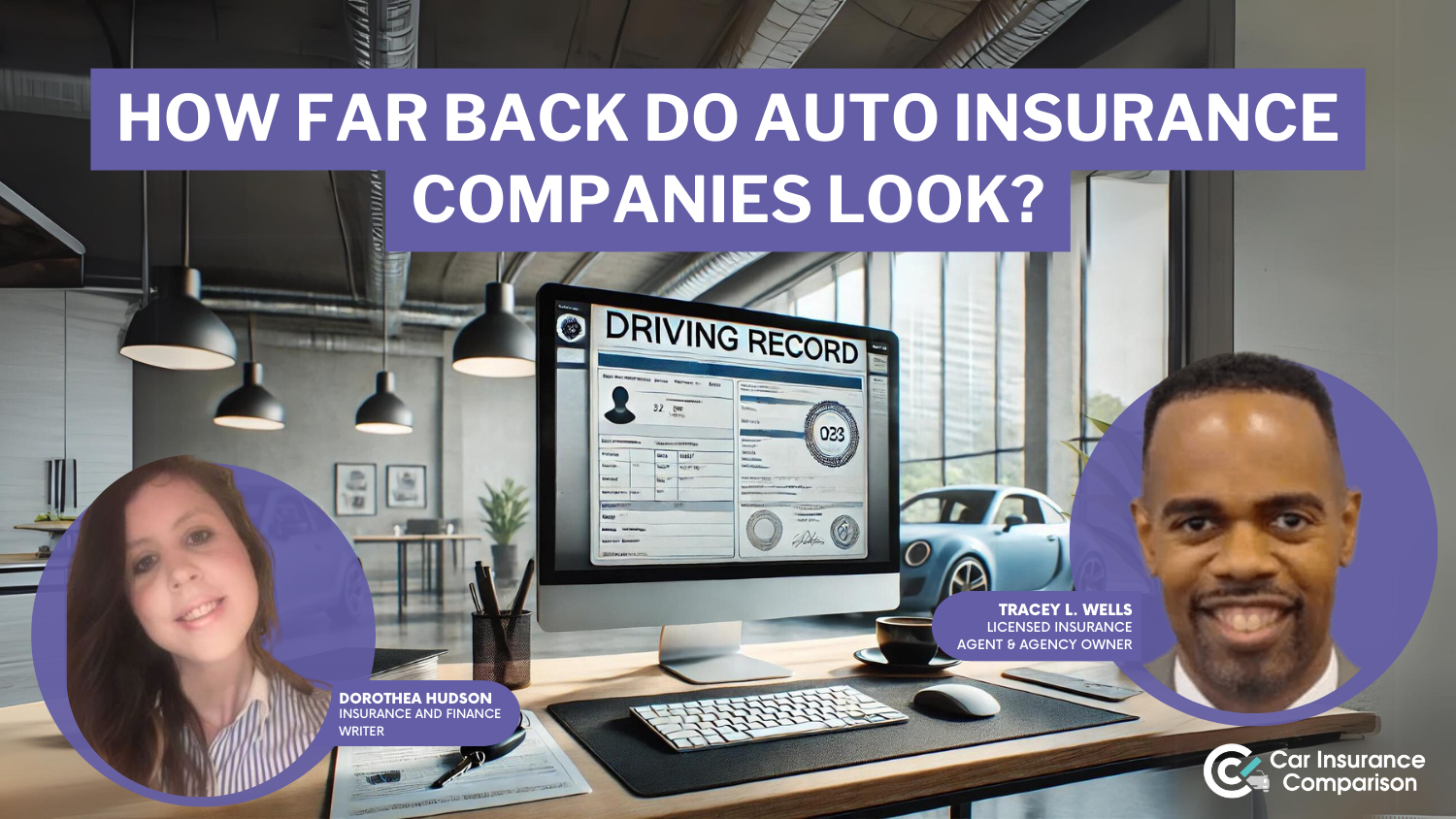 There are limits to how long violations and accidents can stay on a record or be classified as chargeable in most states. State Farm speeding ticket forgiveness is a feature that can benefit drivers with minor infractions. Car insurance with an accident history can affect your premiums and coverage options. Geico’s car insurance underwriting review includes evaluating past incidents to determine the level of risk.
How far do car insurance companies, like Geico, look back? Do all car insurance companies look back three to five years? Understanding your car insurance policy can help you understand how offenses on your record can affect your rates. Read this article to learn more about how far car insurance looks back at your driving record and which violations will cost you the most money on car insurance. (For more information, read our “Compare Best Car Insurance Companies That Only Look Back Three Years”).
Find affordable car insurance in your area now, regardless of how far auto insurance companies look back at your record. Enter your ZIP code in our free tool to get started before you buy car insurance.
- Car insurance companies underwrite all applications to assess risk and calculate rates.
- During underwriting, the underwriter will run a motor vehicle report to look for minor and serious convictions
- Minor violations for infractions like failure to stop and speeding can only be surcharged for 36 months
- Serious violations for reckless driving or driving under the influence can go into rate calculations for between three and seven years
How Car Insurance Companies Use Your Driving Record
Do insurance companies check your driving record? Does your driving record affect your insurance rates? How long does an accident stay on your driving record? Read through the next several sections for everything you need to know about your driving record and your auto insurance rates.
How far back do insurance companies look at driving records?
How far back does a driving record go? It primarily depends on where you live and the type of offense.
If a driver in your household has a moving violation, it’s essential that you know timeframes and when the insurer can see these.
You don’t want to fail to disclose a violation purposely.
Doing this is called material misrepresentation, and it can lead to claims denials, policy cancellations, or at least a misquote.
How long certain violations remain visible on your record depends on the type of violation you’re cited for.
The state you live in may have special laws surrounding how long serious violations stay on your record.
What do car insurance companies check? Here’s a breakdown of how far back car insurance companies look:
- Minor Violations – Speeding, failure to stop, improper turn, improper pass, following too closely, and failure to yield are all examples of minor traffic infractions. These infractions will only stay on your record for three years in most states. At the renewal following the third anniversary of your conviction, the surcharge that raises your rates will fall off.
- Major Violations – Leaving the scene of an accident, driving under the influence, reckless driving, and refusing to stop for an officer are examples of major infractions. Time frames for major violations are a bit different because they tend to be criminal, which is why the period they affect your rates can vary by state. In most states, the violations can affect rates and eligibility for between three and seven years, depending on the nature of the offense.
How far back do insurance companies check for DUI? Some companies go back as far as seven years, but most DUI convictions stay on your driving record for at least ten years.
How long are you considered a high-risk driver?
Drivers are considered high risk for as long as traffic violations and other moving violations are on their record. As we’ve already discussed, the timeframe for violations remaining on record depends both on the severity of the offense and local state laws.
Also, teen drivers are usually considered high risk because of age and lack of experience. And driving without car insurance for more than six months will put in a high-risk driving status with car insurance companies.
Why do car insurance companies care about moving violations?
It’s natural to assume that an insurer will only raise your rates when you cost the company money, but in the world of auto insurance, that’s not the case.
If you get a ticket, it will impact your car insurance. It might not cost the insurer money, but it does affect your risk class as a policyholder.
Getting a traffic ticket shows the insurer that you don’t obey traffic laws that are set to reduce the chances of preventable and devastating crashes occurring.
According to New Jersey state law, the real-world probability of getting into an accident rises when you have one or more violations in recent years; driving infractions will impact your rates.
How do car insurance companies check for violations?
When you shop for insurance, you agree that any company you apply to can run specific reports.
One of these reports is a Motor Vehicle Report (MVR) in the state where you’re licensed.
When you first submit your application, the company can spend up to $27 to pull your report and see if you have any minor or severe violations.
What’s included in your MVR? When insurance companies get a copy of your MVR, they’ll be able to see any accidents or moving violations you’ve been involved in, as well as any criminal convictions that may have resulted from these incidents.
If you’ve ever had your driver’s license suspended, that will show up on the MVR as well, along with any restrictions (like prescription lenses) that may be on your license.
How to Check Your Driving Record
How much will a violation affect your car insurance rates?
While an infraction is chargeable, it can drive up your rates and even disqualify you from receiving a good driver or safe driver discount.
How much a violation impacts your rates depend on the type and the company. Companies have conducted studies to see how much weight is placed on violations.
Here’s how much the study found surcharges to be:
- Reckless driving – 22 percent
- Failure to stop – 15 percent
- Improper turn – 14 percent
- Failure to yield – 9 percent
- Improper pass – 14 percent
- DUI conviction surcharge – 19 percent
How do violations affect car insurance rates? Keep reading to find out.
Best Insurance Companies For High-Risk Drivers
Let’s examine the average annual rates of top car insurance companies based on driving records.
Top Car Insurance Companies' Annual Rates based on Driving Records
| Insurance Company | Average Annual Rates with a Clean Driving Record | Average Annual Rates with 1 Speeding Violation | Average Annual Rates with 1 Accident | Average Annual Rates with 1 DUI |
|---|---|---|---|---|
 | $1,934 | $2,193 | $2,516 | $3,506 |
 | $2,146 | $2,645 | $3,193 | $4,876 |
 | $2,694 | $3,026 | $3,723 | $4,330 |
 | $2,746 | $3,114 | $3,397 | $4,543 |
 | $2,821 | $3,186 | $3,396 | $3,637 |
 | $3,393 | $4,002 | $4,777 | $3,970 |
 | $3,448 | $4,261 | $4,290 | $5,741 |
 | $3,461 | $4,079 | $4,519 | $4,719 |
 | $3,820 | $4,484 | $4,988 | $6,261 |
 | $4,774 | $5,701 | $6,205 | $7,613 |
Look at how many accidents and DUIs affect car insurance rates compared to a clean driving record. You could pay thousands more for car insurance from violations like DUIs and reckless driving.
If you have a DUI, Progressive may be an option to consider, as it appears the company is more lenient on one DUI conviction. Their annual rate for one DUI on a driver’s record is cheaper than the yearly rate with an accident.
What happens if you don’t disclose a violation?
If you’ve failed to disclose a violation of your application, the underwriter will re-evaluate rates and eligibility before issuing your policy. If you have a major infraction that leads to disqualification, you’ll receive a notification.
If you have a significant infraction that leads to disqualification, you’ll receive a notification. If the change increases your rates, you’ll be given the option to proceed with the issuance or to cancel your application.
How far back do car insurance companies look for claims?
Not only do companies look at your driving record, but the underwriter will also run reports to look at your claims history with other carriers.
Believe it or not, insurance companies communicate with one another to help with application evaluation.
Each company reports to the Comprehensive Loss Underwriting Exchange to report when a consumer files an auto claim.
According to Washington State Insurance Commissioners, the Comprehensive Loss Underwriting Exchange (CLUE) will provide the company with seven years of personal auto claims history to make underwriting decisions.
How long insurance companies consider your claims when calculating rates will depend, but in most cases, at-fault claims are only surcharged for three years.
How does credit affect car insurance?
In all but a few states, credit can affect your personal auto insurance rating. It’s why companies run your FICO report or another related report to get a credit insurance score when you apply.
Watch this video to learn more about how your credit score is calculated into the overall insurance score companies to evaluate your perceived risk and adjust your rates accordingly.
A credit report looks back into your credit history to show how you pay your bills, how much debt you have, and how recently you’ve applied for credit.
In most cases, information from the past seven years is examined.
It’s important that you also review how your blemishes can affect your eligibility for discounts. So how much does credit score affect car insurance? Let’s have another look at the top car insurance companies to see how annual rates are affected by credit.
Top Car Insurance Companies' Annual Rates based on Credit History
| Insurance Company | Average Annual Rates with a Good Credit Score | Average Annual Rates with a Fair Credit Score | Average Annual Rates with a Poor Credit Score |
|---|---|---|---|
| $1,821 | $2,220 | $3,691 |
| $2,174 | $2,853 | $4,951 |
| $2,435 | $2,987 | $4,260 |
| $2,692 | $3,170 | $4,468 |
| $2,926 | $3,255 | $4,083 |
| $3,629 | $3,956 | $4,738 |
| $3,677 | $3,899 | $4,864 |
| $3,860 | $4,581 | $6,491 |
| $4,059 | $4,344 | $5,160 |
| $4,388 | $5,604 | $8,802 |
If you’d like to price the cost of coverage to see how your past actions will affect your rates with a handful of insurers, use an online rate comparison tool like the one on this page and start shopping.
By providing all of the infraction details and demographic information just once, you can get dozens of quotes.
- https://www.state.nj.us/mvc/Violations/penalties_pointSchedule.htm
- https://www.massrmv.com/MeritRatingBoard/SurchargeableIncidents/SurchargeableTrafficLawViolation.asp
- https://www.insurance.wa.gov/clue-comprehensive-loss-underwriting-exchange
Free Insurance Comparison
Compare Quotes From Top Companies and Save
Case Studies: How Far Back Do Car Insurance Companies Look?
Case Study 1: Recent Violation
John recently received a speeding ticket for exceeding the speed limit by 10 miles per hour. He contacts various insurance companies to obtain quotes for car insurance coverage. Insurance Company A looks back three years into John’s driving history and considers his recent violation when calculating his premium.
As a result, Insurance Company A offers him a higher premium compared to other companies that only look back two years.
Case Study 2: Clean Driving Record
Sarah has maintained a clean driving record for the past five years. When she applies for car insurance, Insurance Company B conducts a thorough review of her driving history. They only consider incidents that occurred within the past three years when determining her premium.
Due to Sarah’s clean record during that timeframe, Insurance Company B offers her a competitive and lower premium compared to other companies that have a longer lookback period.
Case Study 3: Multiple Accidents and Violations
Mike has a history of multiple accidents and traffic violations. He applies for car insurance with Insurance Company C, which has a lookback period of five years. When evaluating Mike’s driving history, the company takes into account his accidents and violations within that timeframe.
As a result of his extensive record, Insurance Company C offers Mike a higher premium to account for the increased risk associated with his driving history.
Case Study 4: Severity of Incidents
Two years ago, Samantha was in a major accident causing injuries and property damage. She applies for car insurance with Insurance Company D, which evaluates the severity of incidents and considers a lookback period. Insurance companies that only check two years might have different criteria for her application.
Frequently Asked Questions
Do all insurance companies have the same look-back period for driving records?
The look-back period for driving records can vary among insurance companies. Some may consider three years, while others may look back five years or more. Check with individual providers for their specific policies, including insurance companies that only check 2 years, CLUE driving record, and auto insurance accident history.
Can I remove violations from my driving record?
In most cases, traffic violations cannot be removed until the designated time period has passed. However, maintaining a clean driving history over time can improve your record.
How does my driving record affect car insurance rates?
Your driving record influences car insurance rates. Violations and accidents may lead to higher premiums, while a clean record can help qualify for lower rates and discounts.
Can car insurance companies see past accidents?
Yes, car insurance companies can access reports that provide information about past accidents, such as fault determination and claim history.
How long do speeding tickets affect car insurance rates?
Speeding tickets generally impact car insurance rates for three to five years.
How often do car insurance companies check your driving record?
Car insurance companies, such as State Farm, typically check your driving record every three years. This periodic review helps insurers assess risk and adjust rates accordingly.
How often does State Farm check driving records?
State Farm generally reviews driving records when first underwriting a policy and may reassess them periodically, often every few years. This is part of State Farm’s speeding ticket policy and overall approach of State Farm insurance regarding speeding tickets. Comparing Tesla insurance vs State Farm, it’s important to note how each handles driving record checks and ticket policies.
How far back does Geico look at your driving record?
How far back does State Farm check driving record?
State Farm usually reviews driving records for the past 3 to 5 years when assessing insurance applications and renewals.
How far back do insurance companies check driving records?
Insurance companies typically check driving records for the past 3 to 7 years, depending on state regulations and their own policies.
How far back do insurance companies look for DUI?
Does a first-time speeding ticket affect insurance with State Farm?
Does a misdemeanor affect car insurance?
Does a criminal record affect car insurance?
How do insurance companies check driving records?
How far back do insurance companies check medical records?
How far back does AAA run your driver’s license?
How far back do insurance companies look for accidents?
How far back does Liberty Mutual check driving record?
How long do car insurance quotes last?
How long does a chargeable accident stay on your insurance?
How long does Geico underwriting take?
How many years back do car insurance companies look?
How often does Progressive check driving record?
What can insurance companies see on your driving record?
What do car insurance companies look at in your records?
When do accidents fall off insurance with Geico?
When will a speeding ticket show up on insurance with State Farm?
Why did LexisNexis request my driving record?
Related Articles
-
Sep 2024

Car Insurance Deductible: Explained Simply
-
Feb 2025
I can’t remember my car insurance company, how do I find it?
-
Oct 2024
What are the DUI insurance laws in Idaho?
-
Oct 2024

What to Do if Your Car Keys Are Stolen [2026]
-
Oct 2024
What are the DUI insurance laws in Kentucky?
-
Oct 2024
When should I drop collision coverage?


Get a FREE Quote in Minutes
Insurance rates change constantly — we help you stay ahead by making it easy to compare top options and save.