

Can I drive an uninsured car on my own insurance policy?
There are certain types of conditions where you can drive an uninsured car on your insurance policy such as if the vehicle was just purchased, is a rental car, or if it is a temporary replacement vehicle.
Read more





Table of Contents
Table of Contents

Managing Editor
Laura Kuhl holds a Master’s Degree in Professional Writing from the University of North Carolina at Wilmington. Her career began in healthcare and wellness, creating lifestyle content for doctors, dentists, and other healthcare and holistic professionals. She curated news articles and insider interviews with investors and small business owners, leading to conversations with key players in the le...
Laura Kuhl

Licensed Insurance Agent
Justin Wright has been a licensed insurance broker for over 9 years. After graduating from Southeastern Seminary with a Masters in Philosophy, Justin started his career as a professor, teaching Philosophy and Ethics. Later, Justin obtained both his Property & Casualty license and his Life and Health license and began working for State Farm and Allstate. In 2020, Justin began working as an i...
Justin Wright
Updated November 2024
Driving an uninsured vehicle can be dangerous. Not only do you have to worry about getting into an accident without a policy to compensate you for your damages, but you also have to worry about paying legal fees if you’re taken to court for third-party damages.
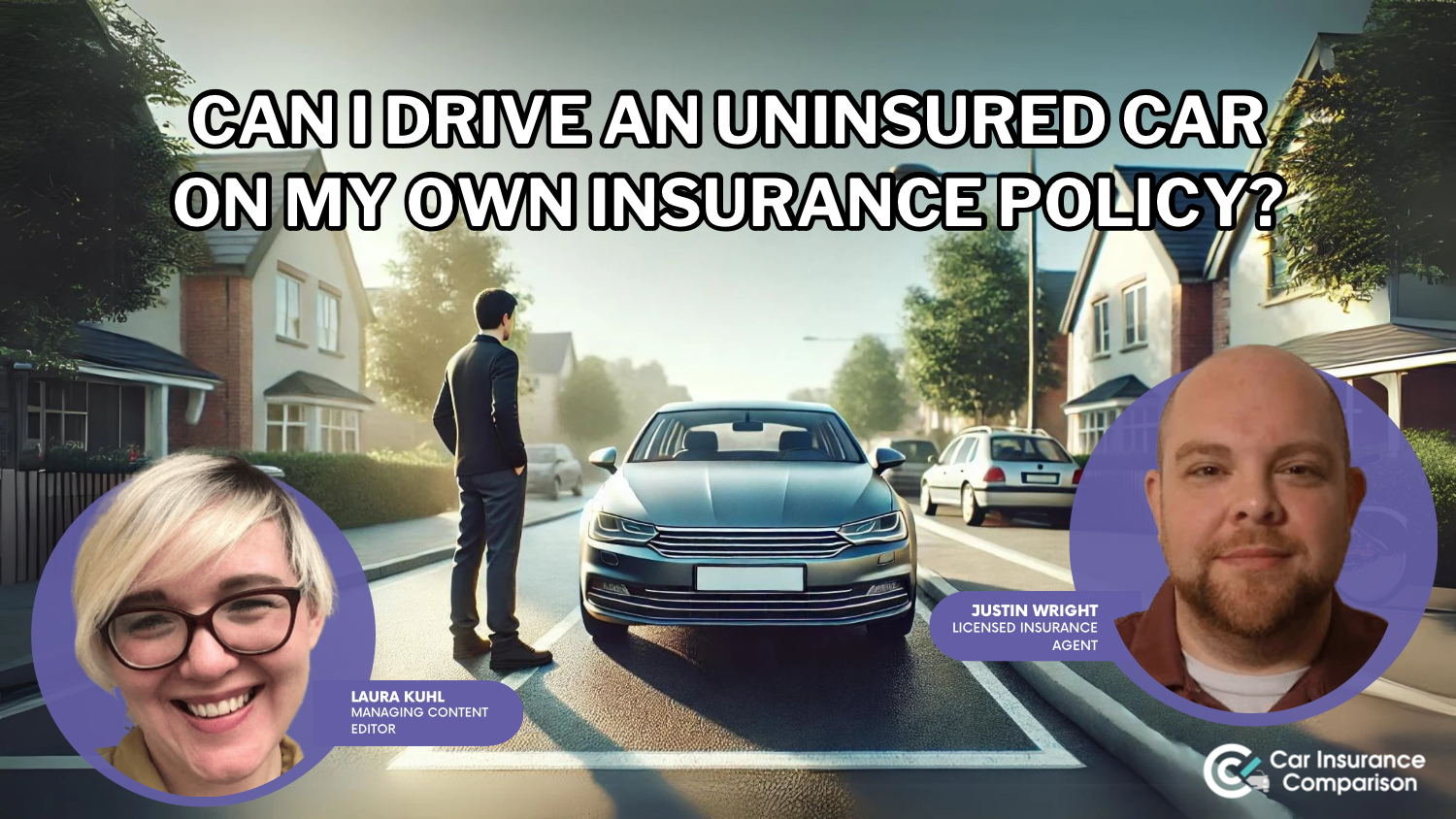
This is one of the prime reasons why a majority of states have compulsory insurance requirements.
Carrying your own insurance coverage protects you while you’re driving vehicles that you own. It’s also possible that your policy will provide you with protection while you’re driving a non-owned vehicle with unknown insurance status.
Finding the ideal car insurance policy is crucial and can present challenges. To ensure it aligns with your insurance requirements (and budget), comparing car insurance quotes from various providers is essential, especially when seeking coverage for situations like car insurance when you don’t own a car or when there’s no insurance on a vehicle.
Enter your ZIP code into our free online quote comparison tool above to do just that and start saving today.
- It’s important to comply with state-mandated insurance laws when you own a vehicle
- Under state law, it’s the vehicle owner who’s held accountable when they don’t carry automobile insurance
- Failure to comply with compulsory insurance laws can result in fines, loss of licensure, and vehicle impoundment
Does personal car insurance cover more than listed vehicles?
An auto insurance policy is full of different terms. The terms must be understood if you really want to translate the language of the policy.
A term that’s defined thoroughly is “covered autos.” As you might assume, a covered auto is a listed vehicle that’s stated on the car insurance declaration page of the policy, but that’s not all your policy covers.
Under the provisions of a personal auto policy, there’s coverage provided for owned vehicles and other private passenger cars that meet certain conditions.
Here are some of the unlisted cars that your policy will cover you driving:
- Newly acquired vehicles purchased after the policy begins
- Replacement vehicle that is replacing a vehicle listed on the policy
- Rental car insurance coverage
- Temporary substitute automobiles are used when your car is being repaired
- Trailers owned by the named insured that can be driven or towed
Free Insurance Comparison
Compare Quotes From Top Companies and Save
Does insurance follow the car or the driver?
As you can see, an auto policy provides a lot more coverage than you might initially think.
Definitions help you to understand policy provisions, but they don’t necessarily help you solve the biggest riddle in the insurance marketplace: Does insurance follow the car or the driver? What happens when an insured driver is driving an uninsured car?
It’s a difficult question to answer simply because insurance can follow the car, the driver, or both depending on the scenario.
Your insurance works very differently if you have a liability loss as opposed to a physical damage loss.
You have to understand how coverage works to fully understand if your coverage is going to kick in when your friend or family member borrows your car.
How does liability coverage work?
Liability insurance, which pays for third-party damages and medical bills, will always follow the driver regardless of whose vehicle is being operated at the time.
Liability is made up of bodily injury liability coverage and property damage liability coverage. The former pays for injuries, the latter pays for vehicle damages or damage to other property.
The only rule is that the vehicle being operated must be considered eligible as a covered vehicle at the time of the loss.
This means that you will have liability coverage when driving a temporary substitute, a replacement vehicle, a trailer, and a newly acquired vehicle.
Coverage isn’t afforded in the following scenarios:
- You have regular access to the car and aren’t a covered driver
- You are a registered owner but don’t have the car under your policy
- The trailer isn’t in your name (you’d need car insurance for trailers)
- The vehicle is owned by someone living in your household
Remember, liability insurance only pays for other people’s damage and medical expenses when you’re the at-fault driver, not yours.
Why does liability insurance follow the driver?
Liability insurance follows you as a driver because it’s designed to protect your assets. Since your assets are still at risk when you’re driving a non-owned vehicle, the company must afford you coverage when you’re in other cars.
Your liability insurance will be deemed secondary and the car’s liability insurance would be deemed primary.
This means your coverage technically kicks in if the primary car insurance company will not pay for a claim or if the vehicle doesn’t have liability coverage at all.
Read more: Compare Primary vs. Secondary Car Insurance: Rates, Discounts, & Requirements
Free Insurance Comparison
Compare Quotes From Top Companies and Save
How does physical damage coverage work?
Physical damage isn’t quite as simple as liability coverage when you’re driving a borrowed car. In most cases, comprehensive coverage and collision coverage are tied to the insured vehicle listed on the policy.
Collision coverage pays for your damages from an accident you caused, while comprehensive coverage pays for damages related to incidents that are not collisions, such as damages related to weather, natural disasters, and theft.
When you’re loaning your car to someone, you’re also loaning your physical damage coverage, but if you’re driving another vehicle your full coverage will more than likely not apply.
Some policies have wording that states that physical damage coverage will carry over to someone else’s vehicle when it’s on the policy.
This depends on the reason why you’re borrowing the vehicle, if it’s a household vehicle, who owns the car, and whether or not it has insurance.
How will medical payments and uninsured motorist coverage extend?
Like liability coverage, both medical payments coverage and uninsured motorist protection will follow the driver and not the car.
If you’re injured in an accident while borrowing an uninsured vehicle, you have peace of mind in knowing your medical payments or uninsured motorist coverage will kick in to help cover medical treatment expenses.
Uninsured/uninsured motorist coverage is a requirement in many states and even if it isn’t, you might consider purchasing it. Our study covering facts about uninsured motorists found that the state with the most uninsured drivers is Mississippi, where 29% of drivers don’t have insurance.
In the majority of states, at least 10% of drivers are uninsured. This isn’t just a problem for them — it could cause a damaging financial situation for you as well.
If you don’t have this type of coverage, you should think carefully about how much it will cost you if you’re involved in an accident with an uninsured driver.
Read More: What is the penalty for driving without insurance in Mississippi?
What are the penalties for driving without car insurance?
The penalties for driving without insurance can be steep. As more and more people are caught driving without compulsory insurance, the fines just get to be harsher.
Here are some of the most common penalties enforced all throughout the nation:
- Fines of up to $1000
- Imprisonment
- Suspension of registration
- Suspension of license
- Impoundment of vehicle
- Community Service
- Reinstatement fees
It’s the vehicle owner’s job to insure their vehicle. If you’re given permission to borrow a car, always ask if it’s insured. If you get pulled over by a police officer and you can’t show proof of insurance, you’re in for a huge hassle, including a potential driver’s license suspension or worse. (For more information, read our “What happens if I drive my car with a suspended registration?“).
If you have a lapse in auto insurance coverage for any reason, you could also find yourself paying much higher insurance premiums down the road. What about an uninsured driver driving an insured car? Generally, your car insurance provider will cover anyone who you’ve allowed to use your vehicle. What about an insured driver driving an uninsured vehicle? If your personal auto policy allows for it in certain circumstances, then yes.
Read more:
Free Insurance Comparison
Compare Quotes From Top Companies and Save
Case Studies: Driving an Uninsured Car on Your Insurance Policy
Case Study 1: Reliance Insurance Company
Case Study 2: Liberty Mutual Insurance
Mark, insured with Liberty Mutual Insurance, borrowed an uninsured car from a family member to run some errands. While driving, he rear-ended another vehicle, causing significant damage. Although Mark had full coverage on his own vehicle, Liberty Mutual Insurance’s driving other cars policy declined coverage for the accident involving the uninsured car parked on the street.
Consequently, Mark had to personally bear the financial burden of repairing both vehicles involved in the accident.
Case Study 3: Allstate Insurance
Lucy, a policyholder with Allstate Insurance, borrowed an uninsured car from a neighbor for a short trip to the grocery store. Unfortunately, she lost control of the vehicle and collided with a parked car. Despite having comprehensive coverage on her own vehicle, Allstate Insurance denied her claim for the accident involving the uninsured car. Lucy had to pay for the damages to both cars out of her own pocket.
Case Study 4: Progressive Insurance
David, insured with Progressive Insurance and having comprehensive coverage for his own car, allowed his uninsured friend to drive his car for a weekend getaway. During the trip, his friend, driving with insurance that does not cover uninsured cars on the road, caused an accident that resulted in significant damage to another vehicle.
Despite David’s fully comprehensive insurance to drive any car through Progressive, the company refused to cover the damages caused by the uninsured driver. As a result, David was personally liable for all the expenses arising from the accident.
Case Study 5: State Farm Insurance
What’s the bottom line?
If you’re in an accident, your liability coverage will protect your assets and wages but your physical damage may not apply. Be sure to review your insurance and see if coverage applies. If you’re confused about anything in your policy, talk to an insurance agent.
No matter what type of insurance policy you have, saving money on car insurance is important to everyone. Plug your ZIP code into our free quote tool below to compare car insurance quotes from multiple insurance providers and start saving today.
Frequently Asked Questions
Can I drive an uninsured car on my own insurance policy?
You can drive an uninsured car under your insurance policy in specific situations, such as when the vehicle is newly purchased, a rental car, or serving as a temporary replacement vehicle. Comprehensive insurance can also cover driving scenarios like these where you don’t own the car.
How does liability coverage work?
Liability insurance follows the driver and is designed to protect your assets. It pays for third-party damages and medical expenses when you’re the at-fault driver, regardless of whether you’re driving your own vehicle or a non-owned vehicle.
How does physical damage coverage work?
Physical damage coverage, such as comprehensive and collision coverage, is usually tied to the insured vehicle listed on the policy. While some policies may extend coverage to other vehicles under certain conditions, it’s important to review your policy to see if coverage applies when driving a borrowed or non-owned vehicle.
Can an insured driver drive an uninsured car?
Yes, typically insurance follows the car rather than the driver. However, coverage can vary based on the specific insurance policy and state laws.
If I have insurance, can I drive an uninsured car?
Your insurance may provide some coverage when driving another car, but it’s important to check your policy as coverage can vary.
If I have full coverage insurance, can I drive someone else’s car?
Full coverage insurance usually applies to the vehicle listed on the policy. It may not extend to other vehicles unless specified in the policy.
Can a car be parked on the road without insurance?
Laws regarding parked cars without insurance vary by state. In some places, all vehicles must have insurance, even if they are not in use.
Can my friend drive my car without insurance?
It’s advisable for anyone driving your car to be insured. Your insurance policy might provide coverage for occasional drivers, but it’s important to verify with your insurer. Can a person be insured to drive any car, even if the car is insured but the driver is not.
Is it illegal to drive an uninsured car?
Yes, it is illegal to drive a car without insurance in most states.
Can I drive a newly purchased car without insurance?
Typically, you must have insurance before driving a newly purchased car off the lot. Dealerships may offer temporary insurance options.
Can I drive another car with comprehensive insurance?
Will Geico cover my car if someone else is driving?
Does fully comprehensive insurance cover other cars?
Does insurance follow the car or the driver in Washington?
Can I insure a car that is not mine?
Can I insure myself to drive any car?
Can I keep an uninsured car on my driveway?
Can someone drive my car if they are not on my State Farm insurance?
Does insurance follow the car or the driver in Georgia?
Does insurance follow the car or the driver in North Carolina?
What happens if you don’t have car insurance and get pulled over?
Does insurance follow the car or the driver in Illinois?
Does insurance follow the car or the driver in Michigan?
Can I drive any car with fully comprehensive insurance?
Can I drive any car with third-party insurance?
Related Articles
Get a FREE Quote in Minutes
Insurance rates change constantly — we help you stay ahead by making it easy to compare top options and save.