
Cheapest Pennsylvania Car Insurance Rates in 2026 (Unlock Savings From These 10 Companies!)
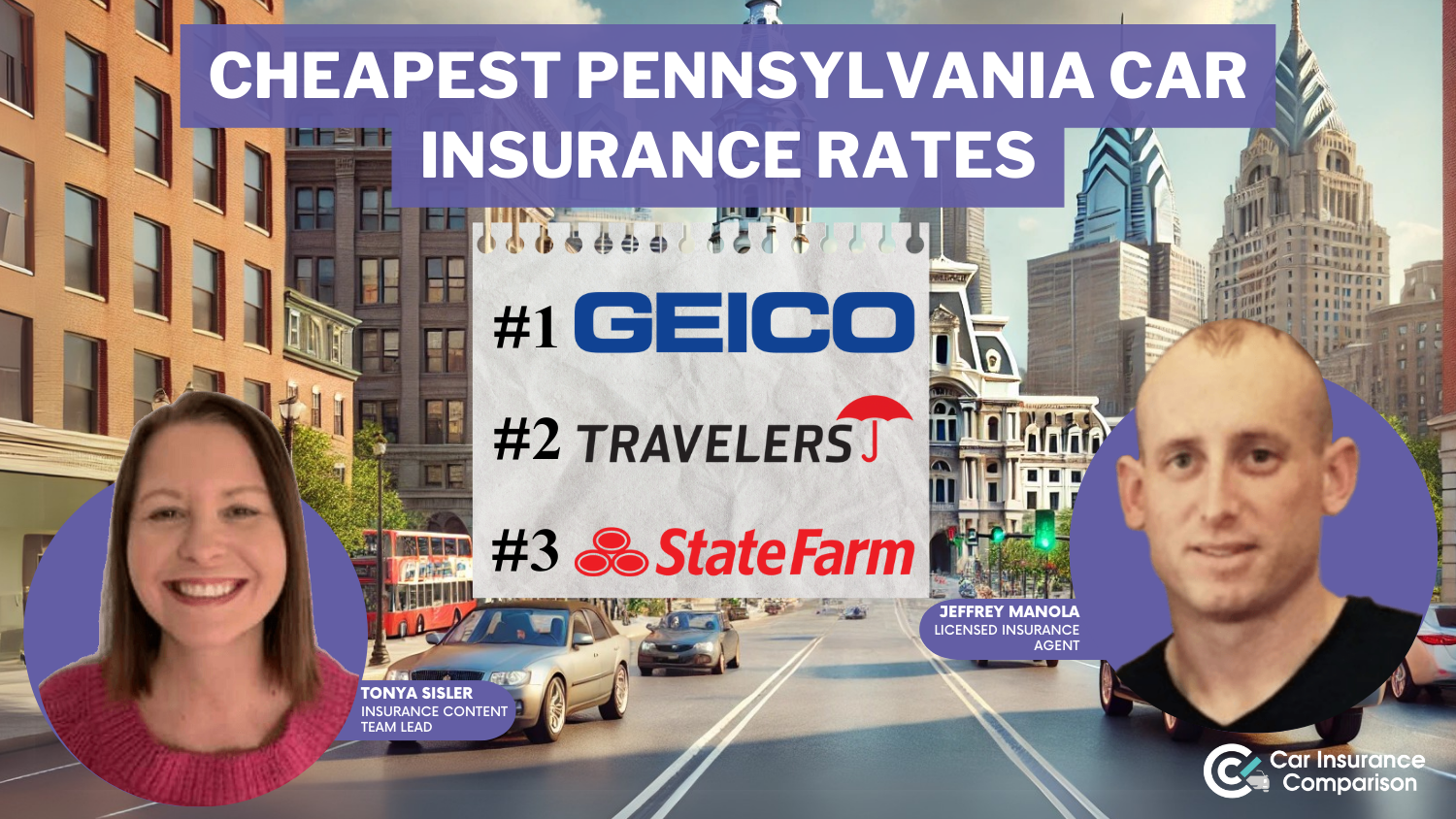
Get the cheapest Pennsylvania car insurance rates from Geico, Travelers, and State Farm, with rates as low as $23 monthly. These car insurance companies offer Pennsylvania drivers affordable rates, discounts, reliable coverage, and unique programs. Compare these top companies to find the best savings for you.
Read more





Find the Lowest Car Insurance Rates Today
Quote’s drivers have found rates as low as $42/month in the last few days!




Table of Contents
Table of Contents

Insurance Content Team Lead
Tonya Sisler has been a technical insurance writer for over five years. She uses her extensive insurance and finance knowledge to write informative articles that answer readers' top questions. Her mission is to provide readers with timely, accurate information that allows them to determine their insurance needs and choose the best coverage. Tonya currently leads a team of 10 insurance copywrite...
Tonya Sisler

Licensed Insurance Agent
Jeffrey Manola is an experienced insurance agent who founded TopQuoteLifeInsurance.com and NoMedicalExamQuotes.com. His mission when creating these sites was to provide online consumers searching for insurance with the most affordable rates available. Not only does he strive to provide consumers with the best prices for insurance coverage, but he also wants those on the market for insurance to ...
Jeffrey Manola
Updated January 2025
19,116 reviewsCompany Facts
Min. Coverage for Pennsylvania
A.M. Best Rating
Complaint Level
Pros & Cons
19,116 reviews 1,734 reviews
Company Facts
Min. Coverage for Pennsylvania
A.M. Best Rating
Complaint Level
1,734 reviews18,157 reviewsCompany Facts
Min. Coverage for Pennsylvania
A.M. Best Rating
Complaint Level
Pros & Cons
18,157 reviews
The cheapest Pennsylvania car insurance rates come from Geico, Travelers, and State Farm with rates as low as $23 monthly. Geico stands out for providing robust digital tools and nationwide availability. Compare these top companies to find the best savings.
To compare Pennsylvania car insurance rates and find the best deal, first decide on your coverage level. Minimum coverage offers cheap car insurance, but isn’t as comprehensive as full coverage.
Our Top 10 Company Picks: Cheapest Pennsylvania Car Insurance Rates
Company Rank Monthly Rates A.M. Best Best For Jump to Pros/Cons

#1 $23 A++ Digital Tools Geico

#2 $25 A++ Policy Discounts Travelers

#3 $26 B Reliable Coverage State Farm

#4 $27 A+ Local Support Erie

#5 $28 A++ Customer Satisfaction Auto-Owners

#6 $29 A+ Vanishing Deductible Nationwide

#7 $31 A+ AARP Benefits The Hartford

#8 $36 A Personalized Service American Family

#9 $44 A Customizable Policies Farmers

#10 $49 A+ Snapshot Program Progressive
We cover everything you need to know, from necessary coverages to insurance laws. Our free online comparison tool above allows you to compare cheap car insurance quotes instantly — just enter your ZIP code to get started.
- Geico known for affordability and digital tools
- Use multi-policy and safe driver discounts for more savings
- Compare cheapest Pennsylvania car insurance rates
- Compare Pennsylvania Car Insurance Rates
- Best York, PA Car Insurance in 2026
- Best Westmoreland City, PA Car Insurance in 2026
- Best Sharon Hill, PA Car Insurance in 2026
- Best Paupack, PA Car Insurance in 2026
- Best New Bethlehem, PA Car Insurance in 2026
- Best Mayport, PA Car Insurance in 2026
- Best Matamoras, PA Car Insurance in 2026
- Best Latrobe, PA Car Insurance in 2026
- Best Lancaster, PA Car Insurance in 2026
- Best Lake Ariel, PA Car Insurance in 2026
- Best Johnstown, PA Car Insurance in 2026
- Best Horsham, PA Car Insurance in 2026
- Best Hatboro, PA Car Insurance in 2026
- Best Hamburg, PA Car Insurance in 2026
- Best Gap, PA Car Insurance in 2026
- Best Easton, PA Car Insurance in 2026
- Best Canonsburg, PA Car Insurance in 2026
- Best Bristol, PA Car Insurance in 2026
- Best Bridgeport, PA Car Insurance in 2026
- Best Bala Cynwyd, PA Car Insurance in 2026
- Best Philadelphia, PA Car Insurance in 2026
#1 – Geico: Top Pick Overall
Pros
- Competitive Rates: Geico offers the cheapest Pennsylvania car insurance rates at an average of $23 per month, making it an ideal choice for cost-conscious drivers looking to save on premiums.
- User-Friendly Online Tools: Geico’s robust online platform and mobile app make managing car insurance policies easy for Pennsylvania drivers, offering convenient features like online quotes, bill payments, and claims tracking.
- Discount Opportunities: Pennsylvania drivers can benefit from Geico’s numerous discount opportunities, including safe driver discounts, multi-vehicle discounts, and military discounts, allowing for significant savings on car insurance. Learn more in our Geico car insurance review.
Cons
- Limited Local Agent Interaction: Geico primarily operates online and via phone, which may not appeal to Pennsylvania drivers who prefer face-to-face interactions with local agents for personalized service.
- Potential Higher Rates for Specific Demographics: Some Pennsylvania drivers, such as those with poor credit or a history of accidents, may experience higher premiums with Geico compared to other insurers.
Free Insurance Comparison
Compare Quotes From Top Companies and Save
#2 – Travelers: Best For Policy Discounts
Pros
- Affordable Premiums: Travelers offers one of the cheapest Pennsylvania car insurance rates, with an average monthly premium of $25, providing substantial savings for budget-conscious drivers in the state.
- Extensive Coverage Options: Travelers provides a variety of coverage options, including liability, collision, comprehensive, and uninsured motorist coverage, allowing Pennsylvania drivers to customize their policies to fit their needs while keeping costs low.
- Discounts for Safe Drivers: Travelers offers discounts for safe driving, multi-policy holders, and good students, helping Pennsylvania drivers reduce their insurance costs even further. See more details on our Travelers car insurance review.
Cons
- Mixed Customer Service Reviews: While many customers are satisfied, some Pennsylvania drivers have reported mixed experiences with Travelers’ customer service, potentially impacting their overall satisfaction with the insurer.
- Limited Availability of Local Agents: In certain rural areas of Pennsylvania, drivers may find fewer local Travelers agents, which could affect the availability of personalized, in-person service.
#3 – State Farm: Best For Reliable Coverage
Pros
- Affordable Premiums: State Farm offers competitive Pennsylvania car insurance rates, with an average monthly premium of $26, making it a cost-effective choice for budget-conscious drivers in the state. Unlock details in our State Farm car insurance review.
- Comprehensive Coverage Options: With extensive coverage options, including liability, collision, and comprehensive insurance, State Farm ensures Pennsylvania drivers can customize their policies to fit their needs while maintaining affordability.
- Discount Programs: State Farm provides a range of discount programs for Pennsylvania drivers, such as safe driver discounts, multi-policy discounts, and student discounts, helping to further reduce the overall cost of car insurance.
Cons
- Limited Availability of Local Agents: While State Farm has a large network of agents nationwide, some rural areas in Pennsylvania may experience limited access to local agents, potentially impacting personalized service.
- Higher Premiums for High-Risk Drivers: State Farm’s affordable rates may not extend to high-risk drivers in Pennsylvania, who may face higher premiums due to factors like driving history or credit score.
#4 – Erie: Best For Local Support
Pros
- Competitive Rates: As mentioned in our Erie car insurance review, Erie offers some of the cheapest Pennsylvania car insurance rates at an average of $27 per month, making it a great option for drivers looking for affordable premiums.
- High Customer Satisfaction: Erie is known for its excellent customer service, consistently receiving high marks for customer satisfaction from Pennsylvania drivers, ensuring a positive insurance experience.
- Comprehensive Coverage Options: Erie provides a wide range of coverage options, including liability, collision, and comprehensive coverage, allowing Pennsylvania drivers to tailor their policies to their specific needs.
Cons
- Limited Availability: Erie is only available in 12 states, including Pennsylvania, which may limit its accessibility for drivers who relocate outside these regions and wish to retain their insurance provider.
- Potentially Higher Rates for Young Drivers: Younger drivers in Pennsylvania may find Erie’s rates less competitive compared to other insurers, potentially facing higher premiums based on their age and driving experience.
Free Insurance Comparison
Compare Quotes From Top Companies and Save
#5 – Auto-Owners: Best For Customer Satisfaction
Pros
- Affordable Premiums: Auto-Owners offers competitive Pennsylvania car insurance rates, with an average monthly premium of $28, providing budget-friendly options for drivers in the state. Check out our page titled Auto-Owners car insurance review to know more details.
- Wide Range of Discounts: Auto-Owners provides various discounts for Pennsylvania drivers, including multi-policy, safe driver, and good student discounts, helping to reduce overall insurance costs.
- Strong Financial Stability: Auto-Owners is known for its financial stability and reliability, giving Pennsylvania drivers confidence in the company’s ability to pay out claims promptly and fairly.
Cons
- Limited Online Tools: Auto-Owners’ online tools and digital resources are less advanced compared to some competitors, which may be a drawback for tech-savvy Pennsylvania drivers who prefer managing their policies online.
- Availability of Local Agents: In some rural areas of Pennsylvania, drivers might find fewer Auto-Owners agents, potentially impacting the availability of personalized, in-person service.
#6 – Nationwide: Best For Vanishing Deductible
Pros
- Affordable Premiums: Nationwide offers competitive Pennsylvania car insurance rates, with an average monthly premium of $29, making it a budget-friendly option for drivers in the state.
- Strong Coverage Options: Nationwide provides a variety of coverage options, including liability, collision, and comprehensive insurance, allowing Pennsylvania drivers to customize their policies to fit their needs while keeping costs low.
- Vanishing Deductible: Nationwide offers a vanishing deductible program, which rewards safe driving by reducing the deductible over time, providing additional savings for Pennsylvania drivers. Check out insurance savings in our complete Nationwide car insurance discount.
Cons
- Mixed Customer Service Reviews: While many customers are satisfied, some Pennsylvania drivers have reported mixed experiences with Nationwide’s customer service, potentially impacting their overall satisfaction with the insurer.
- Higher Premiums for High-Risk Drivers: Nationwide’s affordable rates may not extend to high-risk drivers in Pennsylvania, who may face higher premiums due to factors like driving history or credit score.
#7 – The Hartford: Best For AARP Benefits
Pros
- Competitive Rates: The Hartford offers affordable Pennsylvania car insurance rates, with an average monthly premium of $31, providing cost-effective options for budget-conscious drivers.
- AARP Discounts: The Hartford is known for its partnership with AARP, offering exclusive discounts and benefits to Pennsylvania drivers aged 50 and older, making it an attractive option for senior drivers. Learn more in our page AARP auto insurance program from The Hartford review.
- Comprehensive Coverage Options: The Hartford provides a variety of coverage options, including liability, collision, and comprehensive insurance, allowing Pennsylvania drivers to tailor their policies to their specific needs.
Cons
- Higher Premiums for Younger Drivers: Younger drivers in Pennsylvania may find The Hartford’s rates less competitive compared to other insurers, potentially facing higher premiums based on their age and driving experience.
- Limited Availability: The Hartford primarily focuses on serving older drivers and may have limited availability for younger Pennsylvania drivers or those without an AARP membership.
Free Insurance Comparison
Compare Quotes From Top Companies and Save
#8 – American Family: Best For Personalized Service
Pros
- Competitive Rates: As mentioned in our American Family car insurance review, American Family offers Pennsylvania car insurance rates at an average of $36 per month, making it a cost-effective choice for many drivers in the state.
- Comprehensive Coverage Options: American Family provides a variety of coverage options, including liability, collision, and comprehensive insurance, allowing Pennsylvania drivers to customize their policies to fit their needs while keeping costs low.
- Generous Discounts: Pennsylvania drivers can benefit from American Family’s wide range of discounts, including multi-policy, safe driver, and good student discounts, helping to reduce overall insurance costs.
Cons
- Limited Availability of Local Agents: In some rural areas of Pennsylvania, drivers might find fewer American Family agents, potentially impacting the availability of personalized, in-person service.
- Mixed Customer Service Reviews: While many customers are satisfied, some Pennsylvania drivers have reported mixed experiences with American Family’s customer service, potentially impacting their overall satisfaction with the insurer.
#9 – Farmers: Best For Customizable Policies
Pros
- Affordable Premiums: Farmers offers competitive Pennsylvania car insurance rates, with an average monthly premium of $44, providing budget-friendly options for drivers in the state. Learn more in our Farmers car insurance review.
- Strong Coverage Options: Farmers provides a variety of coverage options, including liability, collision, and comprehensive insurance, allowing Pennsylvania drivers to customize their policies to fit their needs while keeping costs low.
- Discount Programs: Farmers offers numerous discount programs for Pennsylvania drivers, such as safe driver discounts, multi-policy discounts, and good student discounts, helping to reduce overall insurance costs.
Cons
- Limited Availability of Local Agents: In some rural areas of Pennsylvania, drivers might find fewer Farmers agents, potentially impacting the availability of personalized, in-person service.
- Higher Premiums for High-Risk Drivers: Farmers’ affordable rates may not extend to high-risk drivers in Pennsylvania, who may face higher premiums due to factors like driving history or credit score.
#10 – Progressive: Best For Snapshot Program
Pros
- Competitive Rates: Progressive offers Pennsylvania car insurance rates at an average of $49 per month, making it a viable option for drivers seeking affordable premiums in the state. Delve into our evaluation of Progressive car insurance review.
- Innovative Technology: Progressive’s Snapshot program uses telematics to track driving behavior, allowing Pennsylvania drivers to potentially lower their premiums based on safe driving habits, providing additional savings.
- Comprehensive Coverage Options: Progressive provides a wide range of coverage options, including liability, collision, and comprehensive coverage, allowing Pennsylvania drivers to tailor their policies to their specific needs.
Cons
- Mixed Customer Service Reviews: While many customers are satisfied, some Pennsylvania drivers have reported mixed experiences with Progressive’s customer service, potentially impacting their overall satisfaction with the insurer.
- Higher Rates for High-Risk Drivers: Progressive’s competitive rates may not extend to high-risk drivers in Pennsylvania, who may face higher premiums due to factors like driving history or credit score.
Free Insurance Comparison
Compare Quotes From Top Companies and Save
Pennsylvania Insurance Coverage and Rates
Pennsylvania requires all drivers to be insured, and looking through the many options available can make you feel overwhelmed. For the money that you must pay, you want to understand the coverage you get.
Pennsylvania Car Insurance Monthly Rates by Coverage Level & Provider
Insurance Company Minimum Coverage Full Coverage
American Family $36 $108
Auto-Owners $28 $78
Erie $27 $77
Farmers $44 $131
Geico $23 $68
Nationwide $29 $86
Progressive $49 $148
State Farm $26 $76
The Hartford $31 $88
Travelers $25 $75
Our guide will help you get to know what you’re paying for; we’ll explain the major coverage types, insurers, average rates in Pennsylvania and other states, and much more.
So, buckle up and keep reading to learn more.
Pennsylvania Minimum Insurance Coverage
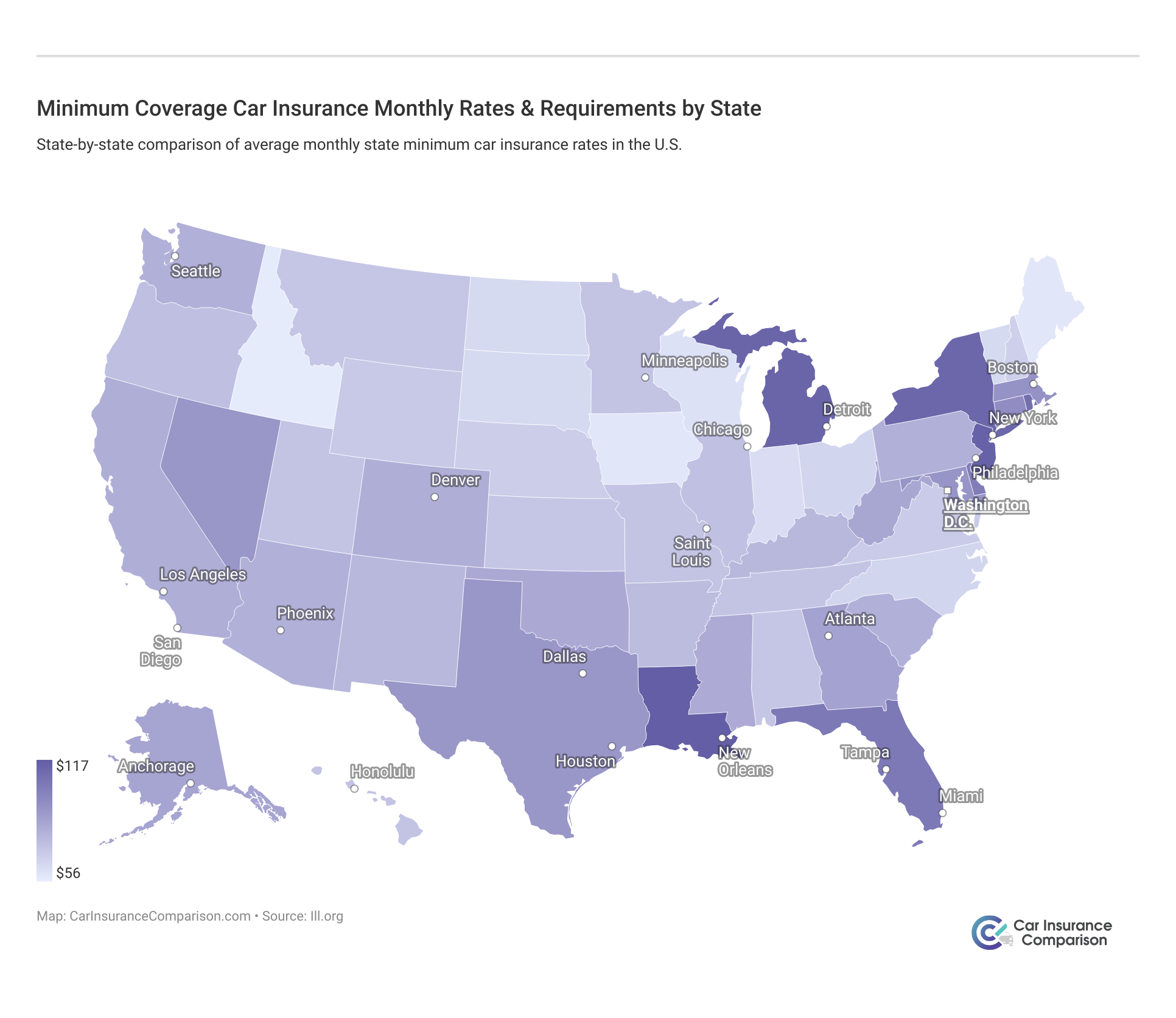
Most states require minimum coverage to ensure the financial responsibility of drivers on the road. Pennsylvania is no different, but minimum costs vary from state to state, as we can see below.
Pennsylvania is a no-fault insurance state, which means that you submit your claim to your insurance company. Your basic personal injury protection (PIP) or medical benefits coverage will pay for your medical bills and certain other out-of-pocket losses regardless of who caused the crash.
Unlike other “no-fault” states, Pennsylvania lets vehicle owners “opt out” of the no-fault system when they buy a car insurance policy. Insurance companies must inform customers of these coverage options: full tort or limited tort coverage.
Limited Tort Coverage: you can seek recovery for all medical and other out-of-pocket losses from an accident, and limited pain and suffering or other non-monetary losses unless your injuries qualify as “serious.” Recent Pennsylvania court decisions show that a “serious” injury often requires critical impairment of a bodily function or permanent and severe disfigurement.
Full Tort Coverage: it costs more, but gives you unlimited rights to sue for medical treatment, pain and suffering, and other out-of-pocket losses when another driver causes a car crash, even if the law doesn’t define your injuries as “serious.”
Read More: Compare Full Tort Car Insurance: Rates, Discounts, & Requirements
Note that Pennsylvania’s no-fault car insurance system doesn’t apply to vehicle damage claims. Someone injured in an accident can file a claim for vehicle damage against the at-fault driver without limits.
All Pennsylvania drivers must have car insurance. State minimum car insurance requirements are:
- $5,000 of Medical Benefits coverage (also known as First-Party Benefits), a form of personal injury protection, to cover medical expenses for yourself or others, regardless of fault
- $15,000 in liability insurance to cover medical costs for injuries to one person, capped at $30,000 per accident
- $5,000 to cover property damage if you’re at fault
- Limited or full tort coverage
Liability insurance pays everyone owed money for property damage and/or injuries from a car accident that you or anyone under your policy has caused – drivers, passengers, pedestrians, bicyclists, etc.
The Keystone State also recognizes certain all-purpose car insurance policies as long as there is a minimum of $35,000 in total coverage.
Remember that if you’re found at fault for a car accident and the injured drivers’ and/or passengers’ losses exceed the limits of your car insurance policy – even if you’ve met the state minimum coverage requirements – you could be responsible for the difference.
So, to protect yourself in case this happens, it makes sense to buy more than the minimum coverage required.
Forms of Financial Responsibility
Liability insurance or self-insurance, or other reliable monetary arrangements, deposits, resources, or commitments filed with PennDOT can provide proof of financial responsibility. If a law enforcement offer pulls you over, you’ll need to provide this proof.
According to PennDOT, drivers must provide proof of insurance in one of the following ways:
- An insurance identification card from an insurer or self-insurance.
- A copy of the insurance declaration page listing the claim holder and insured cars and drivers
- An insurance binder a licensed broker has signed
- A copy of an application for the Pennsylvania Assigned Risk Plan
- A signed letter from the insurance provider on company letterhead
Carrying the proper proof of financial responsibility is crucial for Pennsylvania drivers to avoid penalties. Ensuring you have documentation like an insurance identification card or declaration page can help you stay compliant and drive with confidence.
Self-Insurance
According to PennDOT, Pennsylvania drivers can opt for self-insurance instead of traditional insurance companies, provided they obtain approval from the Department. The requirements for a self-insurance proposal include submitting a self-insurance application, a security agreement, an income statement, and a completed balance sheet reflecting the individual’s or group’s financial standing from the previous year.
Additionally, a minimum collateral of $50,000 is required for one vehicle, and $10,000 for each additional vehicle, which can be in the form of U.S. currency, Treasury bills, loans, escrow deposits, or bonds. Next, we’ll examine the average amount Pennsylvanians spend on car insurance to help you assess affordability.
Premiums as a Percentage of Income
In 2014, the annual per capita disposable personal income (DPI) in Pennsylvania, after taxes were paid, was $42,414.
The average annual cost of car insurance in Pennsylvania is $950, which is two percent of the average DPI and about the same as nearby states; this number remained steady from 2012 to 2014.
The average Pennsylvanian has $3,535 each month to buy food, pay bills, etc. Car insurance will take about $79 out of that, and possibly more if your driving record isn’t entirely spotless.
CalculatorPro
Average Car Insurance Rates in PA (Liability, Collision, Comprehensive)
You can expect car insurance rates in Pennsylvania to be significantly higher for 2019 and on. This increase reflects broader trends in insurance costs, driven by factors such as rising claim frequencies and higher repair expenses.
Remember: though having the required insurance is essential, you should also buy additional coverage to protect yourself and others in case you’re in an accident.
Ready for more? Now, let’s see some stats about loss ratios in Pennsylvania.
Additional Liability Coverage
A loss ratio compares how much a company spends on claims to how much money they take in on premiums. A loss ratio of 60 percent indicates the company paid $60 on claims out of every $100 earned in premiums.
Pennsylvania Additional Liability Coverage by Loss Ratio
| Loss Ratio | 2021 | 2022 | 2023 |
|---|---|---|---|
| Medical Payments (MedPay) | 252% | 37% | 9% |
| Uninsured/Underinsured Motorist Coverage (UUM) | 66% | 67% | 64% |
| Personal Injury Protection (PIP) Payments | 74% | 71% | 71% |
Pennsylvania drivers can buy uninsured/underinsured motorist coverage to protect themselves, especially if the driver responsible for an accident doesn’t have the required minimum liability insurance.
Uninsured/underinsured motorist coverage is optional in Pennsylvania, however, as we explained earlier, a minimum of $5,000 of Medical Benefits or First-Party Benefits coverage is required.
How much risk you’re willing to take when you drive is up to you, whether you want to get the minimum or buy more coverage to protect yourself and your loved ones from extra costs and potential lawsuits from damaging accidents.
The experts at the Wall Street Journal advise drivers who buy liability insurance make sure that they increase the limits to 100/300/50. In 2015, 13 percent of drivers in the U.S. and eight percent of Pennsylvania motorists were uninsured despite the potential penalties.
Add-ons, Endorsements, Riders
We know getting the complete coverage you need for an affordable price is your goal.
Some Pennsylvania drivers want to add certain types of coverage to their insurance policies to further protect themselves. These types of coverage are not required.
DriveSense is one of the usage-based auto insurance programs available in Pennsylvania via a mobile app through Esurance (an Allstate company), as is IntelliDrive by Travelers. Metromile, with mileage tracking through a free wireless device, is another option. These programs, especially if you drive fewer than 15,000 miles per year, can provide decent car insurance discounts.
You can add many more powerful but cheap extras to your policy.
Optional coverage includes:
- Gap Insurance
- Personal Umbrella Policy (PUP)
- Rental Car Reimbursement
- Emergency Roadside Assistance
- Breakdown Car Insurance
- Non-Owner Car Insurance
- Modified Car Insurance Coverage
- Classic Car Insurance
Exploring optional coverage options can enhance your auto insurance policy while keeping costs manageable. By considering programs like DriveSense and IntelliDrive, drivers can take advantage of potential discounts tailored to their driving habits.
Average Car Insurance Rates by Age & Gender in PA
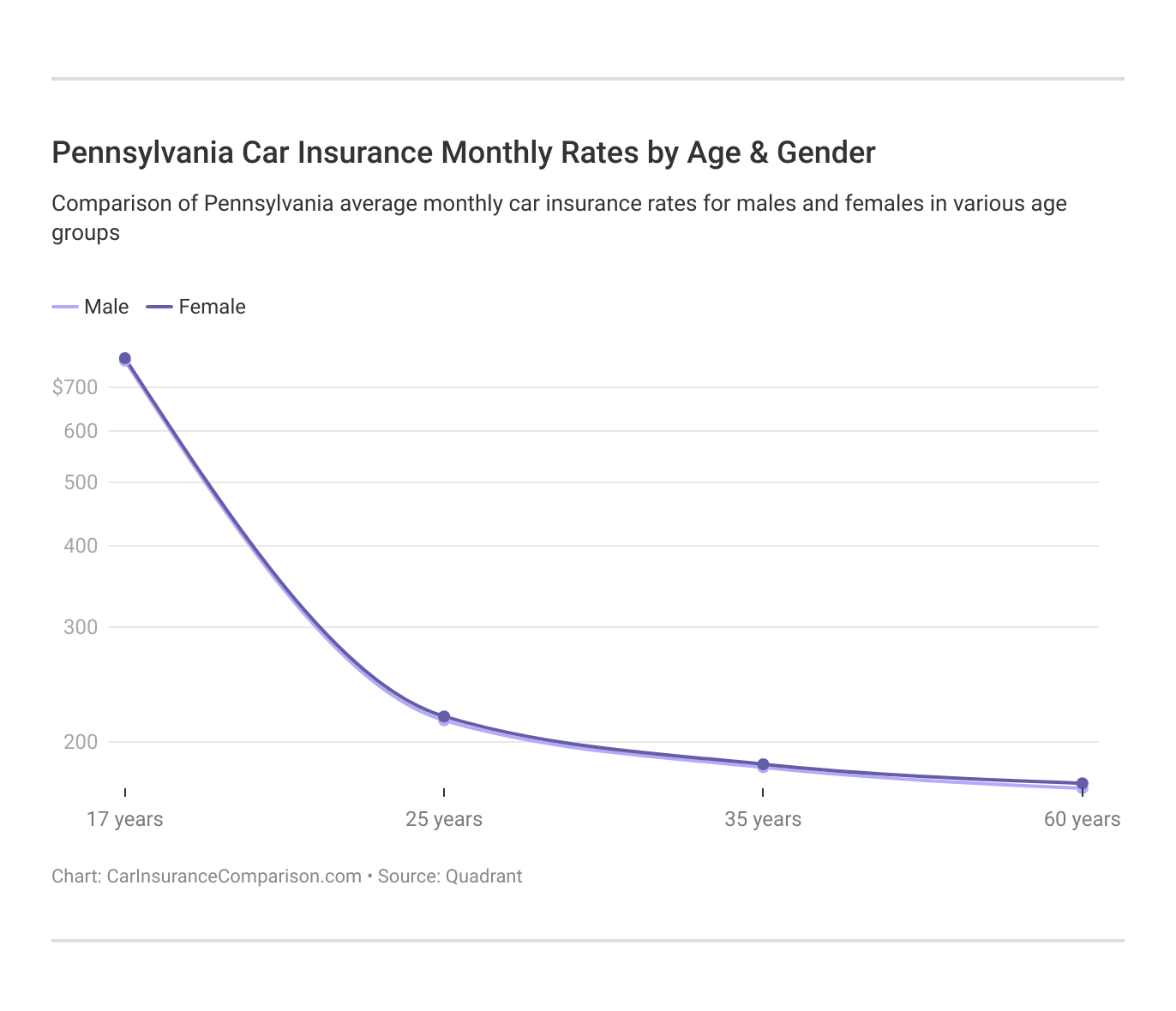
We partnered with Quadrant to collect the data below. As you’ll see, your gender can affect your car insurance rates in Pennsylvania.
The analysis of average car insurance rates by age and gender highlights the significant impact these factors can have on pricing in Pennsylvania. Being aware of these differences can empower consumers to shop wisely and secure the best rates available.
Pennsylvania Car Insurance Monthly Rates by Age, Gender, & Provider
| Insurance Company | Age: 17 Male | Age: 17 Female | Age: 25 Male | Age: 25 Female | Age: 35 Male | Age: 35 Female | Age: 60 Male | Age: 60 Female |
|---|---|---|---|---|---|---|---|---|
| Allstate | $349 | $349 | $115 | $115 | $104 | $104 | $96 | $96 |
| Geico | $185 | $214 | $75 | $86 | $74 | $86 | $70 | $81 |
| First Liberty | $483 | $483 | $210 | $210 | $166 | $166 | $152 | $152 |
| Nationwide | $223 | $223 | $89 | $89 | $80 | $80 | $76 | $76 |
| Progressive | $373 | $373 | $148 | $148 | $117 | $117 | $104 | $104 |
| State Farm | $248 | $248 | $78 | $78 | $70 | $70 | $62 | $62 |
| Travelers | $534 | $534 | $88 | $88 | $73 | $73 | $79 | $79 |
| USAA | $145 | $145 | $64 | $64 | $48 | $48 | $43 | $43 |
As shown, Travelers’ rates for single 17-year-old male and female drivers are more than double that of the next closest insurer, First Liberty Insurance. Regardless of your age, gender, or marital status, it pays to find the best rates.
Pennsylvania Insurance Companies
With more than 10 million registered drivers in the commonwealth, there are a lot of car insurance options available, and it can be hard to settle on just one. It usually comes down to who offers the most coverage at the best price.
You’ll see lots of promises about rates and coverage, but it’s vital that insurers truly deliver on them. You’re lucky that you’re here because we’ve saved you time and done the homework for you.
It gets better: below, you’ll find company ratings, credit histories, and much more to help you narrow down the right insurance coverage for you.
A.M. Best Financial Strength Ratings From the Top Pennsylvania Car Insurance Providers
| Insurance Company | A.M. Best |
|---|---|
| Allstate | A+ |
| Erie | A+ |
| Farmers | A |
| Geico | A++ |
| Liberty Mutual | A |
| Nationwide | A+ |
| Progressive | A+ |
| State Farm | B |
| Travelers | A++ |
| USAA | A++ |
AM Best assigns financial ratings to insurance companies. A good score means they’re likely to stay solvent and be able to pay customers’ claims.
Pennsylvania Companies With the Most and Least Complaints
When a consumer is unhappy with an insurer, they can file a complaint. This feedback is part of a company’s complaint ratio, which is the number of complaints a company receives per one million dollars of business.
Pennsylvania Companies With the Most and Least Complaints
| Insurance Company | Complaint Number | Complaint Index |
|---|---|---|
| State Farm | 431 | 2 |
| Erie | 366 | 2 |
| Allstate | 326 | 2 |
| Nationwide | 274 | 1 |
| Geico | 258 | 1 |
| Progressive | 156 | 1 |
| Travelers | 65 | 1 |
| Penn National | 48 | 1 |
| USAA | 44 | 1 |
| Liberty Mutual | 34 | 1 |
In Pennsylvania, some insurance companies have significantly higher complaint numbers and indexes, indicating customer dissatisfaction. Conversely, other companies maintain lower complaint indexes, reflecting better customer experiences.
Cheapest Companies in Pennsylvania
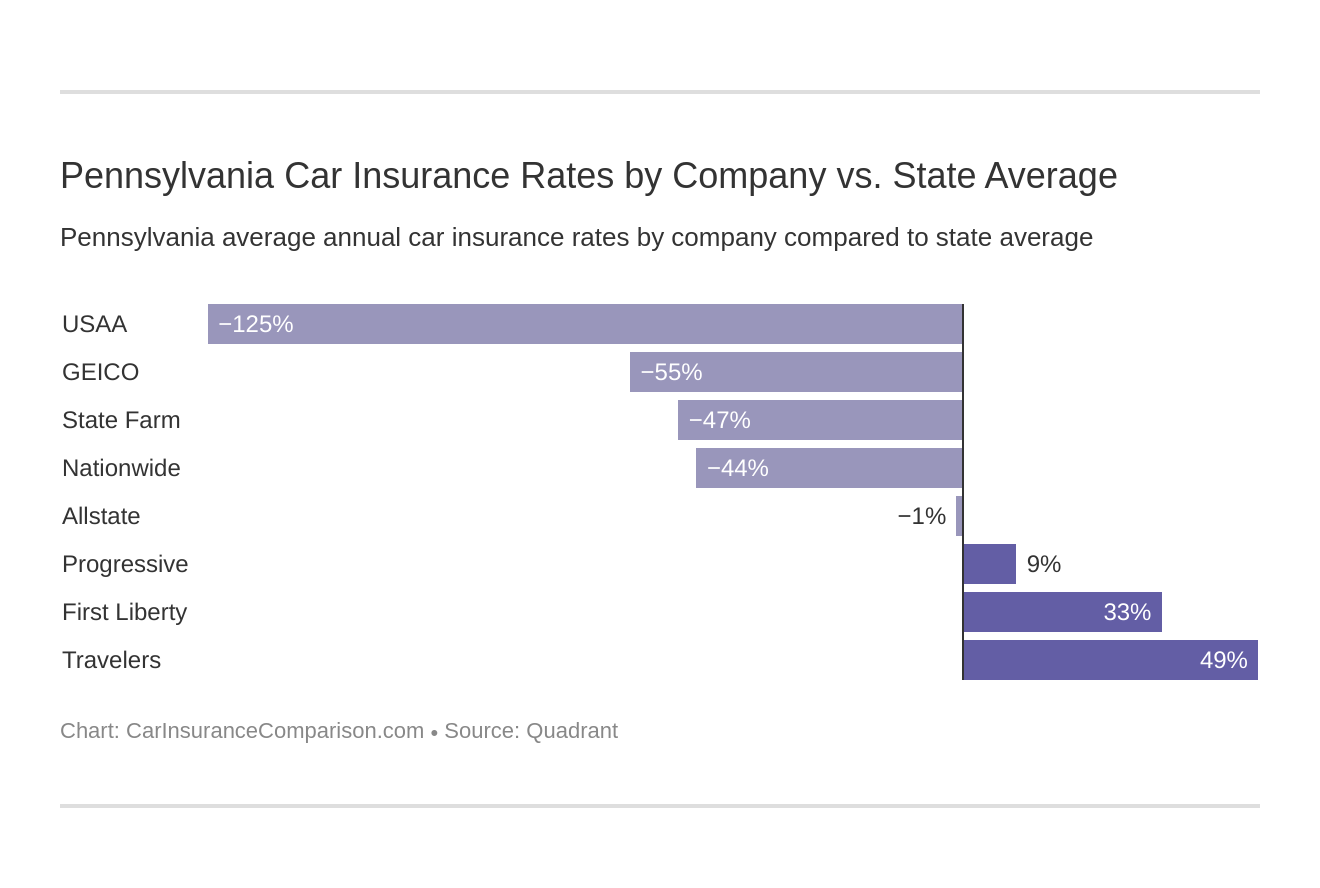
Travelers tops the list and USAA is on the lowest side, but a number of other options are available in-between. Read our Travelers car insurance review for more information.
Pennsylvania Credit History Rates
Car insurance companies will usually examine your credit score to determine the rates they will offer you. Drivers who have good credit will often get better rates or a good credit discount.
Pennsylvania Full Coverage Car Insurance Monthly Rates by Credit Score & Provider
| Insurance Company | Bad Credit | Fair Credit | Good Credit |
|---|---|---|---|
| Allstate | $240 | $192 | $160 |
| American Family | $140 | $112 | $93 |
| Farmers | $162 | $130 | $108 |
| Geico | $135 | $108 | $90 |
| Liberty Mutual | $563 | $450 | $375 |
| Metromile | $105 | $84 | $70 |
| Nationwide | $173 | $138 | $115 |
| Progressive | $152 | $121 | $101 |
| State Farm | $101 | $80 | $67 |
| Travelers | $225 | $180 | $150 |
| USAA | $102 | $82 | $68 |
| U.S. Average | $115 | $140 | $210 |
The average Pennsylvanian has a credit score of 687, they have around three credit cards in their name, and a balance of $6,146. This score is slightly above the 2017 national credit score of 675.
Your credit score is crucial in determining your car insurance rates.
Now, let’s look at the rules of the road.
Pennsylvania Rates by Carrier and Driving Record
This table provides a comparison of full coverage car insurance rates from top carriers in Pennsylvania, based on different driving records. It highlights how various infractions, such as accidents, DUIs, and tickets, impact monthly premiums.
Pennsylvania Full Coverage Car Insurance Monthly Rates by Driving Record & Provider
| Insurance Company | Clean Record | One Accident | One DUI | One Ticket |
|---|---|---|---|---|
| Allstate | $212 | $318 | $392 | $265 |
| American Family | $227 | $341 | $422 | $285 |
| Amica | $210 | $315 | $388 | $260 |
| Farmers | $316 | $474 | $582 | $395 |
| Geico | $178 | $267 | $328 | $225 |
| Liberty Mutual | $284 | $426 | $524 | $355 |
| Progressive | $238 | $357 | $439 | $299 |
| State Farm | $175 | $263 | $324 | $222 |
| The Hartford | $248 | $372 | $459 | $312 |
| USAA | $152 | $228 | $282 | $192 |
It’s clear that even one DUI or accident can skyrocket your rates, so it’s best to drive safely and take care behind the wheel to keep them low.
How Much Auto Insurance Costs in Pennsylvania
Pennsylvania Car Insurance Cost by City
Understanding auto insurance costs across different Pennsylvania cities allows drivers to make more informed decisions. By considering the various factors influencing rates, consumers can better navigate their insurance options and find the best coverage for their needs.
Largest Car Insurance Companies in Pennsylvania
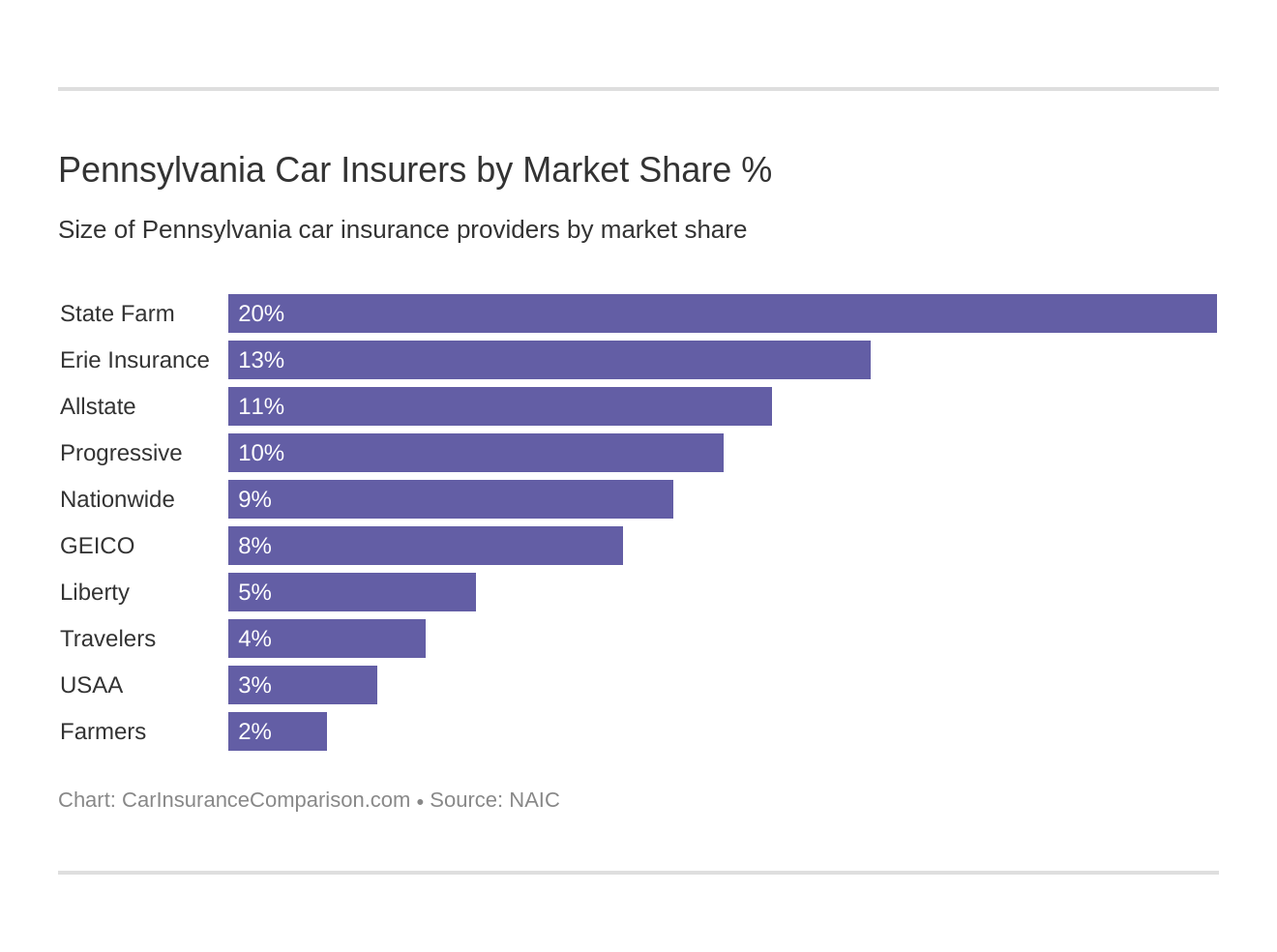
Understanding the market share of car insurance companies in Pennsylvania can help consumers make informed decisions when selecting coverage. This chart shows which car insurance companies have the largest market share in the state.
With State Farm leading the market, exploring options from other major providers like Erie and Allstate may also yield competitive rates and services.
Number of Insurers in Pennsylvania
Pennsylvania has a total of 166 domestic property and casualty insurers and 929 “foreign” insurers. Domestic insurance is formed under Pennsylvania law, but foreign insurance is created under the laws of any state.
Pennsylvania Laws
Every state has different laws, and some make more sense than others. It’s easy to get confused.
You’ll find everything you need to know to avoid penalties here.
Some laws, like seat belt and DUI requirements, are common knowledge, but we’ll cover distracted driving and some obscure regulations, such as drugged driving, automation, and so on to keep you safe on the road. You may be able to get non-smoker/non-drinker car insurance discounts if you avoid drinking and driving.
Car Insurance Laws
As we stated before, Pennsylvania requires every driver to have car insurance. Below you’ll find out about some of the aspects of insurance coverage, such as windshield repairs, high-risk insurance, and fraud.
Keep reading to learn how the state forms its car insurance laws.
How State Laws for Car Insurance are Determined
State insurance commissioners administer laws and regulations, and they have considerable influence on car insurance. Each state determines the type of tort law and threshold that applies, the type and amount of liability insurance required, and how they approve insurer rates and forms.
Each state has also enacted different car seat belt requirements, drunk driving laws, and maximum speed limits.
Insurance companies in Pennsylvania are subject to the regulations the state insurance commissioner sets, which must meet the fair competition standards of the National Association of Insurance Commissioners (NAIC).
Windshield Coverage
In the Keystone State, the consumer can choose the repair vendor. It’s good to be aware, however, that no Pennsylvania law prohibits the use of aftermarket or used glass in windshield repair. Also, many auto insurance policies for Pennsylvania drivers provide a high deductible for glass replacement or don’t offer coverage.
Generally, a comprehensive insurance policy includes benefits for repair work or even a full vehicle replacement if someone steals your car or if collisions, fire, weather, and other incidents damage your vehicle. This type of insurance often has full glass replacement benefits, but not all comprehensive policies do.
With a zero-deductible full glass coverage option on your policy, your insurance company pays for the cost of the repair or replacement work up to the limits of your coverage, and you won't need to pay a deductible.
Michelle Robbins LICENSED INSURANCE AGENT
However, if the coverage limit is less than the replacement cost, you will have to fund the difference. Pennsylvania doesn’t legally require auto insurance companies to offer zero-deductible car insurance, so you’ll need to check your coverage to see if you have it.
If you have a deductible for full glass coverage, you should compare your deductible amount against the quotes that you receive for glass repair or replacement. You also should analyze your coverage limits.
The bottom line? These details can help you determine if it’s worth filing a claim.
High-Risk Insurance
If you have several tickets, accidents, or DUI convictions on your driving records, insurance companies may see you as a “high-risk” for coverage.
So, if you struggle to get insured in the traditional marketplace, and have been denied coverage for a minimum of 60 days, you may be able to find coverage under the Pennsylvania Assigned Risk Plan (ARP). This organization will assign your policy to a carrier, however, it may cost more than a standard policy.
The Keystone State doesn’t require the filing of an SR-22 or certificate of financial responsibility for high-risk policies, however, you may need to file one to meet other states’ guidelines.
Learn More: What is SR-22 car insurance?
Low-Cost Insurance
Pennsylvania doesn’t currently offer a government-sponsored insurance program for low-income drivers. The best way to lower your rates is to keep a clean driving record. But, there are still many other ways to cut costs.
Ask your provider about the following potential discounts:
- Good driver discount
- Good student discount
- Anti-theft device discount
- Multi-car discount
- Homeowner’s discount
- Usage-based driving discount
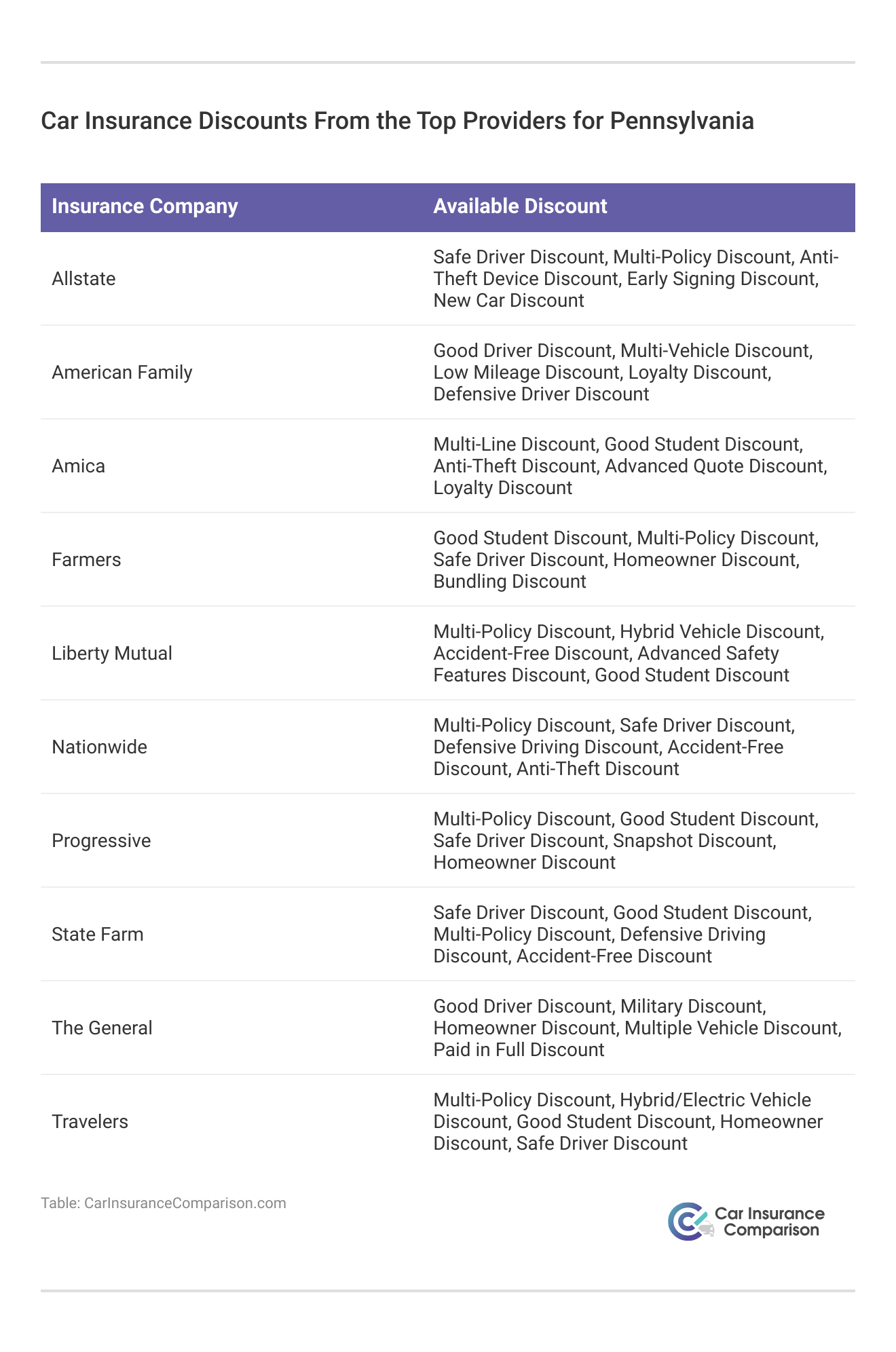
Since Pennsylvania lacks a government-sponsored low-income insurance program, the best strategy to reduce your rates is to maintain a clean driving record and inquire about available discounts. Additionally, comparing offers from different providers can uncover further savings opportunities.
These discounts from top insurance providers in Pennsylvania offer valuable opportunities for car owners to save money while maintaining comprehensive coverage and safety on the road.
Automobile Insurance Fraud in Pennsylvania
Insurance fraud is the second largest economic crime in America. To combat fraud, insurance companies raise premium rates dramatically and pass them on to consumers.
There are two classifications of fraud: hard and soft.
- Hard Fraud: A purposefully fabricated claim or accident
- Soft Fraud: A misrepresentation of information to the insurance company
Soft fraud is more common than hard fraud. Twenty to 40 percent of consumers admitted to lying to their insurer about one of the following:
- Number of annual miles driven
- Number of drivers in the household
- How the vehicle would be used
In Pennsylvania, a person is guilty of insurance fraud if he or she acts in one of several ways specified in the statute “with the intent to defraud” another party, whether it’s an agency, insurer, or self-insured individual. Offenders face prison time, legal fees, and more.
Any way you slice it, insurance fraud is a crime. Any willful misrepresentation of facts is known as “rate evasion” and is a $16 billion annual expense to car insurers.
If you suspect insurance fraud or have been a victim of it, contact the Pennsylvania Insurance Department to report it.
Statute of Limitations
The statute of limitations is the time you have left to file and resolve an insurance claim or bring a lawsuit. In Pennsylvania, drivers have two years to file a personal injury or a property damage insurance claim or lawsuit.
It’s easy to lose track of time. And, the closer you get to the deadline, the harder it may be to collect crucial evidence for your case. If you miss the filing deadline, you could lose the chance to seek payment for your losses.
Vehicle Licensing Laws
All Pennsylvania drivers must have a license or permit to operate a motor vehicle. The licensing process involves a series of tests to ensure each driver can operate a car safely without endangering others.
Residents can renew their registrations and drivers’ licenses, update their addresses, and even take practice driving tests through PennDOT Driver & Vehicle Services.
Penalties for Driving Without Insurance
Drivers in Pennsylvania must have valid car insurance to operate a motor vehicle legally. As we mentioned above, all residents must also be financially responsible and provide proof of insurance. If a driver is found to have had a lapse in insurance coverage, the following penalties for driving without insurance may apply:
- A $300 fine
- Three-month vehicle registration suspension with a restoration fee
- Three-month license suspension with an $88 restoration fee, unless the insurance coverage lapse was less than 32 days
- Vehicle impoundment
PennDOT might also want to prove that the vehicle in question wasn’t used during the time it wasn’t insured. If a license or registration is suspended, the driver must turn in their driver’s license, and the car’s license plate and registration sticker to PennDOT.
After their suspension period ends, drivers typically must pay fees and submit proof of a current insurance policy to restore their license and driving privileges.
Teen Driver Laws
Teens in Pennsylvania can start driving with a learner’s permit at age 16. Finding young drivers car insurance can be difficult.
Pennsylvania Teen Driver Laws
| Licensing Laws | Minimum Age | Passenger Restrictions | Time Restrictions |
|---|---|---|---|
| Learner's Permit | 16 | Must have a licensed driver of at least 21 years of age, or a parent, guardian or spouse over the age of 18 in the front seat with at all times | 65 hours, ten of which must be at night and five of which must be in inclement weather |
| Provisional License | 16 years old and six months | first six months: no more than one passenger younger than 18; thereafter, no more than three passengers (family members excepted) | Between 11 p.m. and 5 a.m. |
| Full License | 12 months and age 17 if completed driver education or age 18 (min. age: 17) | restrictions lifted after 12 months and age 17 if completed driver education or age 18 (min. age: 17) | restrictions lifted after 12 months and age 17 if completed driver education or age 18 (min. age: 17) |
Navigating Pennsylvania’s teen driver laws ensures young drivers gain experience safely. Adhering to these guidelines helps teens transition to full driving privileges responsibly.
Older Driver License Renewal
Drivers age 65 and older in Pennsylvania can opt to renew their licenses every two or four years. Proof of adequate vision isn’t required at every renewal. Additionally, PennDOT allows all license holders to renew online or through the mail.
New Resident Licensing
All new residents with out-of-state non-commercial driver’s licenses must get a Pennsylvania driver’s license within 60 days of moving to the commonwealth. They must apply in person at a Driver License Center and meet these requirements:
- Surrender their out-of-state driver’s license (valid or expired in six months or less)
- Present acceptable proof of identification and residency and a Social Security card
- Complete an application for a driver’s license
- Pass a vision exam
- Pay applicable fees
All documents must show the same name and date of birth or an association between the information on that paperwork. Additional documentation may be required if a connection between documents cannot be established (e.g., marriage certificate, court order of name change, divorce decree, etc.)
Out-of-state learner’s permits cannot be transferred to Pennsylvania. Also, if your out-of-state driver’s license has been expired for more than six months, it can’t be transferred for a Pennsylvania license. To get a license, you must apply for a Pennsylvania learner’s permit and complete all applicable knowledge and skills tests.
License Renewal Procedures
Pennsylvania drivers must renew their licenses every four years. Proof of adequate vision isn’t required. Drivers age 65 and older can choose to get their licenses renewed every two or every four years. PennDOT allows all license holders to renew online or through the mail.
Negligent Driving
Reckless driving or negligent driving, the disregard for the safety of people or property that causes injury or harm, is a form of negligence. Victims have a right to file a civil claim and seek compensation from the at-fault party. It’s based on the concept that everyone has a responsibility not to harm others.
Pennsylvania comparative negligence laws state that someone injured in a crash can hold a level of fault for the accident and still recover damages. Under this law, each party in a negligence claim is assigned a percentage of fault. This percentage reflects how much their action (or inaction) contributed to the accident and injuries.
It’s important to understand these percentages in a personal injury case. Pennsylvania follows a 51 percent comparative negligence rule, which means you can recover damages if you were found to be less than 51 percent at fault. If you’re considered more than 50 percent at fault, you can’t seek compensation for damages.
The laws provide that your degree of responsibility is directly related to the amount of compensation due to you. For example, if you’re considered to hold 20 percent of the fault, you will be entitled to only 80 percent of the settlement. The Pennsylvania comparative negligence laws go hand-in-hand with the Fair Share Act of Pennsylvania, which dictates that defendants can be held liable only for their share of fault.
This usually occurs when there is more than one defendant, such as a multi-car collision with an injured accident victim who files a suit against two other drivers, one who is 55 percent at fault and the other who is 45 percent at fault. Under the Act, rather than being accountable for the whole settlement regardless of the percentage of fault, defendants are only responsible for their exact share of fault.
Therefore, the driver who was 45 percent at fault would be liable only for 45 percent of the damages, and the driver 55 percent at fault would be responsible for 55 percent. However, if a defendant is found to be 60 percent or more at fault for a crash, the Fair Share Act mandates that he or she will be accountable for the entire amount of the damages.
Rules of the Road
All Pennsylvania drivers must know and follow the state traffic laws to safely and responsibly operate a motor vehicle. When drivers violate those laws, they can receive a ticket, fine, or a suspension, depending on the severity of the violation.
These penalties can affect your ability to get the best car insurance rates in Pennsylvania. To stay safe, keep reading to learn more about Pennsylvania’s rules of the road.
Fault vs. No-Fault
As we explained earlier, Pennsylvania is a “no-fault” accident state. And, as we also mentioned, the comparative negligence laws of the Keystone State determine who is at fault for a crash. It’s important to keep this information in mind in case of an accident.
Seat Belt and Car Seat Laws
All children younger than two years must be in a rear-facing child restraint until the child outgrows the manufacturer’s top height or weight recommendations; children ages two to three years must be in a forward-facing child safety seat, and ages four through seven years in a booster seat.
Pennsylvania law doesn’t state a preference for rear-facing car seats for children. Children ages 8-17 in all seats can wear adult safety belts. Seat belt laws also definitely affect car insurance.
Read More: Do seat belt laws impact my car insurance?
When you bundle, you don’t have to pick 😉 #NFLDraft pic.twitter.com/LL0aBcY0Dm
— GEICO (@GEICO) April 27, 2023
Everyone 18 years and older who sits in the front seat must wear a seat belt. The fine for not wearing one while seated there is $10, and it’s considered a secondary offense, which means that another violation, such as running a red light, is required to enforce the law.
The maximum base fine for failing to seat children properly is $75, and an officer can pull a driver over for this offense.
Cargo Areas in Pick Up Trucks: Pennsylvania restricts sitting in cargo areas to people 18 and older if the vehicle is traveling at less than 35 mph; the law doesn’t apply to occupants 17 and younger if the cargo area is enclosed. Otherwise, the law allows people to occupy cargo areas for parades, hunting, and farming.
Keep Right and Move Over Laws
Pennsylvania state law requires drivers approaching an emergency response area, including areas where a tow truck is offering assistance, to pass in a non-adjacent lane if it’s safe and possible to do so or slow down to a safe speed. The law also applies to utility vehicles in the first 72 hours after a declared emergency or until a declared emergency expires, whichever occurs later.
Speed Limits
Adhering to posted speed limits is crucial to avoiding costly tickets and maintaining a clean driving record. Knowing and following these limits can help you drive safely and stay compliant with state regulations.
Pennsylvania Speed Limits
| Road Type | Speed Limit |
|---|---|
| Rural Interstates | 70 mph |
| Urban Interstates | 70 mph |
| Other Limited Access Roads | 70 mph |
| Other Roads | 55 mph |
Please note that these are only the maximum speed limits for each road type – they can vary from roadway to roadway, so pay attention to signs.
Ridesharing
Rideshare services like Uber and Lyft mandate that all their drivers carry personal car insurance policies that align or exceed the minimum coverages state law requires.
If you’re thinking of ridesharing, make sure to ask your provider if they offer rideshare car insurance. In Pennsylvania, those companies include Erie, Geico, Liberty Mutual, and Progressive.
Automation on the Road
According to the Insurance Institute for Highway Safety (IIHS), Automation is the use of a machine or technology to do a task or function a human once performed. In driving, automation involves using radar, camera, and other sensors to get information about a vehicle’s surroundings, which computer programs use to do all or part of the driving.
Pennsylvania law allows for automation on the road, depending on the vehicle. The Pennsylvania Department of Transportation (PennDOT) voluntary guidance authorizes testing of “highly automated vehicles.” Pennsylvania law authorizes the deployment of “highly automated work zone vehicles” effective April 22, 2019.
PennDOT voluntary guidance requires a licensed operator to test “highly automated vehicles,” but Pennsylvania law doesn’t address operator licensing for “highly automated work zone vehicles.” The law requires an operator to occupy the vehicle to test “highly automated vehicles,” but “highly automated work zone vehicles” don’t require an operator.
Safety Laws
Traffic laws are designed to keep everyone safe. PennDOT offers some general driving safety tips and more resources at its website. For more information about state safety laws, read on.
DUI Laws
What are the DUI insurance laws in Pennsylvania? The Blood-Alcohol Content (BAC) limit in Pennsylvania is 0.08 percent, and the high BAC limit is 0.16 percent.
Drug-Impaired Driving Laws
Pennsylvania not only bans driving while under the influence of marijuana, it’s also illegal to drive with any amount over one nanogram per milliliter of THC, the active ingredient in marijuana that causes a “high,” or its metabolites, in the blood.
Under the Per Se law for DUI of marijuana, prosecutors don’t have to show that your driving was impaired. Aspects of Per Se laws to remember:
- Unlike DWI tests that establish blood-alcohol content (BAC) levels within two hours of driving, cannabinoid levels need only to show in your bloodstream at the time of arrest.
- Ethanol, the intoxicating compound in alcohol, is water-soluble, meaning it’s quickly expelled from your system.
- Cannabinoids like THC bind with fatty cells – they remain in your bloodstream long after the intoxicating effects are gone.
- Drug testing is a two-step process in which the state’s lab first identifies the drug and then runs more complex procedures to confirm that drug’s concentration in your blood.
Anyone can be charged with a drug DUI even if they’re not impaired while driving because the metabolites, or residue from the drug, can stay in the body for days, weeks, and possibly even months later.
Distracted Driving Laws
Since the smartphone became popular, distracted driving has become as dangerous as driving under the influence of substances.
Pennsylvania state law bans texting for all drivers, however, they can use handheld devices. State law supersedes any local distracted driving laws.
And remember: in Pennsylvania, an officer can pull you over just for texting on your phone. So, it’s better to be safe than sorry and save the texting for off the road.
Free Insurance Comparison
Compare Quotes From Top Companies and Save
Pennsylvania Can’t-Miss Facts
Let’s check out some Pennsylvania vehicle theft and crash statistics.
Vehicle Theft in Pennsylvania
Vehicle theft remains a significant concern in Pennsylvania, with certain models being targeted more frequently. The following table highlights the most stolen vehicles, reflecting trends in car theft across the state.
Top 10 Pennsylvania Car Thefts by Model
| Make & Model | Year | Total Thefts |
|---|---|---|
| Honda Accord | 1997 | 544 |
| Honda Civic | 2000 | 539 |
| Ford Pickup (Full Size) | 2006 | 303 |
| Hyundai Elantra | 2017 | 277 |
| Toyota Camry | 2019 | 269 |
| Nissan Altima | 2015 | 261 |
| Hyundai Sonata | 2013 | 257 |
| Chevrolet Impala | 2008 | 224 |
| Toyota Corolla | 2018 | 210 |
| Chevrolet Pickup (Full Size) | 2003 | 203 |
The Honda Accord and Civic are the most stolen vehicles in Pennsylvania in 2024. It’s crucial to take extra precautions if you own one of these models.
Vehicle Theft by City
Car theft rates vary significantly across Pennsylvania cities, highlighting areas with higher risks. The table below outlines the number of auto thefts reported in various towns and cities, providing insights for car owners to enhance their security measures.
Top 10 Pennsylvania Car Thefts by City
| City | Total |
|---|---|
| Pittsburgh | 818 |
| Allentown | 282 |
| York | 193 |
| Reading | 190 |
| Harrisburg | 135 |
| Upper Darby Township | 120 |
| Scranton | 108 |
| Erie | 104 |
| Chester | 100 |
| Lancaster | 81 |
Pittsburgh has the highest number of car thefts in Pennsylvania for 2024, with 818 reported incidents. Car owners in these cities should be extra vigilant and take preventive measures to protect their vehicles.
Dangers on the Road in Pennsylvania
Below you’ll find data on how weather and light conditions factored in car crash deaths.
Fatal Crashes by Weather Condition and Light Condition
The table below breaks down fatal crashes in Pennsylvania by weather and light conditions. It highlights how adverse weather conditions like rain and snow contribute to fewer fatal crashes compared to normal road conditions.
Pennsylvania Fatal Crashes by Weather Condition and Light Condition
| Weather Condition | Daylight | Dark, but Lit | Dark | Dawn or Dusk | Other / Unknown | Total |
|---|---|---|---|---|---|---|
| Normal | 168 | 40 | 97 | 10 | 0 | 315 |
| Rain | 49 | 16 | 23 | 4 | 0 | 92 |
| Snow/Sleet | 15 | 1 | 7 | 2 | 0 | 25 |
| Other | 5 | 4 | 12 | 5 | 0 | 26 |
| Total | 569 | 170 | 297 | 45 | 2 | 1,083 |
Normal road conditions saw the highest number of fatal crashes in Pennsylvania. Adverse weather conditions, such as rain, snow, and sleet, resulted in significantly fewer fatal crashes.
Risky and Harmful Behavior
Here are some sobering facts to keep in mind about driving-related fatalities in Pennsylvania.
Fatality Rates Rural vs. Urban
The table compares traffic fatalities between rural and urban areas in Pennsylvania. It shows that urban areas have a higher incidence of fatalities than rural regions, underscoring the need for enhanced safety measures in densely populated areas.
Pennsylvania Traffic Fatalities by Area Type
| Type | Total |
|---|---|
| Rural | 645 |
| Urban | 854 |
Driving in urban areas of Pennsylvania poses a higher risk of fatalities compared to rural areas. Staying vigilant and adopting safe driving practices is crucial to reducing these alarming numbers across all regions.
Fatalities by Person Type
The table provides a breakdown of traffic fatalities in Pennsylvania by person type for 2024. It highlights the distribution among different road users, emphasizing the need for targeted safety measures for each category.
Pennsylvania Traffic Fatalities by Person Type
| Type | Total |
|---|---|
| Passenger Vehicle Occupants | 740 |
| Motorcyclists | 155 |
| Pedestrian | 170 |
| Bicyclist and Other Cyclist | 30 |
| Non-Occupants | 40 |
Understanding these statistics highlights the importance of targeted safety measures to protect all individuals on the road.
Fatalities by Crash Type
In 2024, Pennsylvania traffic fatalities were classified by crash type, revealing various contributing factors. Analyzing these statistics can help inform safety initiatives and driver education efforts.
Pennsylvania Traffic Fatalities by Crash Type
| Type | Total |
|---|---|
| Involving a Single Vehicle | 630 |
| Involving a Large Truck | 145 |
| Involving Speeding | 405 |
| Involving a Rollover | 120 |
| Involving a Roadway Departure | 510 |
| Involving an Intersection (or Intersection Related) | 290 |
Addressing the most prevalent crash types is essential for improving road safety across the state. Implementing targeted strategies can significantly reduce the risk of fatal accidents in the future.
Fatalities Involving Speeding by County
The data on speeding fatalities in Pennsylvania reveals trends across various counties from 2021 to 2023. This information underscores the ongoing challenge of speeding-related accidents and highlights areas that require focused attention.
Pennsylvania Speeding Fatalities by County
| County Name | Total Fatalities (2021) | Total Fatalities (2022) | Total Fatalities (2023) |
|---|---|---|---|
| Philadelphia | 30 | 28 | 32 |
| Berks | 17 | 16 | 18 |
| Westmoreland | 15 | 14 | 16 |
| Dauphin | 12 | 11 | 13 |
| Allegheny | 20 | 18 | 21 |
| Bucks | 18 | 17 | 19 |
| Fayette | 10 | 9 | 11 |
| Montgomery | 19 | 18 | 20 |
| Washington | 14 | 13 | 15 |
| Chester | 12 | 11 | 13 |
| Lancaster | 16 | 15 | 17 |
| Erie | 10 | 9 | 11 |
| Luzerne | 14 | 13 | 15 |
| Butler | 8 | 7 | 9 |
| Clearfield | 6 | 5 | 7 |
| Cumberland | 13 | 12 | 14 |
| Delaware | 15 | 14 | 16 |
| Franklin | 9 | 8 | 10 |
| York | 20 | 19 | 22 |
| Lehigh | 11 | 10 | 12 |
| Bedford | 5 | 4 | 6 |
| Centre | 6 | 5 | 7 |
| Schuylkill | 8 | 7 | 9 |
| Beaver | 7 | 6 | 8 |
| Lackawanna | 9 | 8 | 10 |
| Lebanon | 7 | 6 | 8 |
| Monroe | 10 | 9 | 11 |
| Greene | 4 | 3 | 5 |
| Northampton | 11 | 10 | 12 |
| Somerset | 5 | 4 | 6 |
| Susquehanna | 3 | 2 | 4 |
| Clinton | 4 | 3 | 5 |
| Lycoming | 8 | 7 | 9 |
| Wyoming | 3 | 2 | 4 |
| Adams | 5 | 4 | 6 |
| Armstrong | 4 | 3 | 5 |
| Clarion | 3 | 2 | 4 |
| Fulton | 2 | 1 | 3 |
| Lawrence | 6 | 5 | 7 |
| Mercer | 5 | 4 | 6 |
| Tioga | 3 | 2 | 4 |
| Blair | 7 | 6 | 8 |
| Bradford | 5 | 4 | 6 |
| Cambria | 6 | 5 | 7 |
| Columbia | 4 | 3 | 5 |
| Crawford | 5 | 4 | 6 |
| Indiana | 5 | 4 | 6 |
| McKean | 3 | 2 | 4 |
| Northumberland | 6 | 5 | 7 |
| Perry | 4 | 3 | 5 |
| Snyder | 3 | 2 | 4 |
| Union | 2 | 1 | 3 |
| Warren | 3 | 2 | 4 |
| Carbon | 4 | 3 | 5 |
| Elk | 2 | 1 | 3 |
| Huntingdon | 3 | 2 | 4 |
| Jefferson | 3 | 2 | 4 |
| Mifflin | 2 | 1 | 3 |
| Montour | 1 | 1 | 2 |
| Forest | 1 | 0 | 2 |
| Juniata | 2 | 1 | 3 |
| Potter | 1 | 0 | 2 |
| Sullivan | 1 | 0 | 2 |
| Venango | 3 | 2 | 4 |
| Wayne | 4 | 3 | 5 |
| Cameron | 1 | 0 | 2 |
| Pike | 3 | 2 | 4 |
Fatalities in Crashes Involving an Alcohol
The statistics on DUI fatalities in Pennsylvania highlight the concerning trends across various counties from 2021 to 2023. This data serves as a reminder of the ongoing impact of alcohol-related crashes on public safety.
Pennsylvania DUI Fatalities by County
| County Name | Total Fatalities (2021) | Total Fatalities (2022) | Total Fatalities (2023) |
|---|---|---|---|
| Allegheny | 35 | 37 | 39 |
| Philadelphia | 42 | 45 | 47 |
| Chester | 18 | 20 | 21 |
| Bucks | 25 | 27 | 29 |
| Montgomery | 30 | 32 | 34 |
| York | 17 | 18 | 19 |
| Berks | 20 | 22 | 23 |
| Westmoreland | 16 | 17 | 18 |
| Erie | 14 | 15 | 16 |
| Dauphin | 15 | 16 | 17 |
| Delaware | 22 | 24 | 25 |
| Luzerne | 12 | 13 | 14 |
| Butler | 11 | 12 | 13 |
| Cumberland | 14 | 15 | 16 |
| Fayette | 10 | 11 | 12 |
| Lancaster | 19 | 20 | 21 |
| Lebanon | 8 | 9 | 10 |
| Washington | 13 | 14 | 15 |
| Cambria | 9 | 10 | 11 |
| Lackawanna | 10 | 11 | 12 |
| Lehigh | 14 | 15 | 16 |
| Northampton | 12 | 13 | 14 |
| Schuylkill | 11 | 12 | 13 |
| Somerset | 5 | 6 | 7 |
| Beaver | 10 | 11 | 12 |
| Clearfield | 6 | 7 | 8 |
| Lycoming | 8 | 9 | 10 |
| Mercer | 9 | 10 | 11 |
| Monroe | 11 | 12 | 13 |
| Perry | 4 | 5 | 6 |
| Adams | 6 | 7 | 8 |
| Armstrong | 5 | 6 | 7 |
| Blair | 7 | 8 | 9 |
| Bradford | 4 | 5 | 6 |
| Crawford | 5 | 6 | 7 |
| Mifflin | 3 | 4 | 5 |
| Susquehanna | 2 | 3 | 4 |
| Bedford | 3 | 4 | 5 |
| Carbon | 4 | 5 | 6 |
| Clinton | 3 | 4 | 5 |
| Elk | 2 | 3 | 4 |
| Franklin | 7 | 8 | 9 |
| Fulton | 1 | 2 | 3 |
| Lawrence | 4 | 5 | 6 |
| Northumberland | 6 | 7 | 8 |
| Potter | 1 | 2 | 3 |
| Tioga | 3 | 4 | 5 |
| Warren | 2 | 3 | 4 |
| Wyoming | 1 | 2 | 3 |
| Centre | 5 | 6 | 7 |
| Clarion | 2 | 3 | 4 |
| Forest | 1 | 2 | 3 |
| Greene | 3 | 4 | 5 |
| Huntingdon | 2 | 3 | 4 |
| Indiana | 5 | 6 | 7 |
| Juniata | 1 | 2 | 3 |
| McKean | 2 | 3 | 4 |
| Montour | 1 | 2 | 3 |
| Pike | 3 | 4 | 5 |
| Snyder | 2 | 3 | 4 |
| Union | 1 | 2 | 3 |
| Venango | 3 | 4 | 5 |
| Wayne | 4 | 5 | 6 |
| Cameron | 1 | 2 | 3 |
| Columbia | 4 | 5 | 6 |
| Jefferson | 2 | 3 | 4 |
| Sullivan | 1 | 2 | 3 |
Addressing the rise in DUI fatalities requires a multi-faceted approach, including increased awareness and stricter enforcement of laws. Collaborative efforts can help reduce these preventable tragedies and foster safer communities.
Teen Drinking and Driving
In Pennsylvania, in 2016 there were 365 arrests of teens under age 18 for drinking and driving. That amounted to roughly 136 arrests per million people. The state ranks 12th overall for the number of underage DUI arrests.
The percentage of alcohol-impaired driving fatalities per 100,000 of the population in 2016 for those under 21 in Pennsylvania was 0.8, which was lower than the national average of 1.2.
EMS Response Times
The data on EMS response times in Pennsylvania reveals significant differences between rural and urban areas. This information is crucial for understanding how geographic location affects emergency service efficiency.
Pennsylvania EMS Response Time
| Location | Notification | Arrival |
|---|---|---|
| Rural | 6 | 11 |
| Urban | 3 | 7 |
Improving response times in both rural and urban settings is essential for enhancing patient outcomes. Investing in resources and training can lead to faster emergency care and potentially save lives.
Transportation
These are some interesting details about car ownership and commute time in Pennsylvania.
Car Ownership
As the chart above shows, Pennsylvanians own an average of two cars.
Commute Time
At 25.6 minutes, Pennsylvania drivers have a slightly longer commute time than the national average of 25.3 minutes. Only three percent of Pennsylvanians have a “super commute” of 90 minutes or more. You can get lower car insurance by driving less.
Commuter Transportation
Seventy-six percent of drivers drove alone in their commutes, more than carpooling or taking public transportation.
According to the TomTom Traffic Index, three Pennsylvania cities are among the most traffic-congested: Philadelphia, Pittsburgh, and Allentown.
- Philadelphia: it’s the state’s most congested city. Worldwide, it ranks 125th on the list of most traffic-congested cities, at 23 percent overall. In the daytime, congestion reaches 37 percent, and in the evening, it rises to 49 percent.
- Pittsburgh: Pennsylvania’s second most congested city ranked 146th worldwide. Overall congestion is 19 percent. In the mornings, commute time reaches 30 percent, and in the evening it increases to 39 percent.
- Allentown: ranked 163rd worldwide, it has an overall congestion level of 17 percent; in the daytime, it reaches 21 percent, and in the evening, 32 percent.
We hope you’ve found this comprehensive guide useful and that you’ve learned something about Pennsylvania car insurance and laws.
Ready to find cheap car insurance in Pennsylvania today? Compare Pennsylvania car insurance rates with our free quote comparison tool.
Frequently Asked Questions
How are car insurance rates determined in Pennsylvania?
Car insurance rates in Pennsylvania are determined by various factors, including your driving record, age, gender, location, the type of vehicle you drive, coverage options chosen, and your credit history. Insurance companies use these factors to assess the level of risk you pose as a driver and calculate your premium accordingly.
Are car insurance rates higher in Pennsylvania compared to other states?
Car insurance rates in Pennsylvania can vary compared to other states. The rates are influenced by factors such as population density, traffic congestion, weather conditions, and state-specific insurance regulations. While rates may differ, it’s important to compare quotes from multiple insurance providers to find the best rate for your specific situation.
Read More: Compare Car Insurance Rates by State
Are there any minimum car insurance requirements in Pennsylvania?
Yes, Pennsylvania requires all drivers to carry minimum liability coverage. The minimum requirements include $15,000 for bodily injury per person, $30,000 for bodily injury per accident, and $5,000 for property damage liability. These requirements ensure that drivers have a basic level of coverage to protect themselves and others in the event of an accident.
How can I find the best car insurance rates in Pennsylvania?
To find the best car insurance rates in Pennsylvania, compare quotes from multiple insurers, assess your coverage needs, and look for discounts such as safe driving or bundling policies. Check customer reviews for satisfaction levels and consider consulting an insurance agent for personalized advice.
Get fast and cheap car insurance coverage today with our quote comparison tool above.
What are some pros of comparing car insurance rates in Pennsylvania?
Comparing car insurance rates in Pennsylvania can lead to cost savings by finding more affordable premiums, allow you to customize coverage to better suit your needs, and reveal insurers offering additional benefits or unique policy features. It also helps you select a provider known for excellent customer service and reliability.
What are some cons of comparing car insurance rates in Pennsylvania?
Comparing car insurance rates in Pennsylvania can be time-consuming and may lead to information overload, making it difficult to choose the best option. Additionally, some insurance companies might not be included in comparisons, potentially missing competitive options. Frequent changes in providers for lower rates can also cause inconvenience and require adjustments to your coverage.
What factors influence car insurance rates in Pennsylvania?
Several factors that affect car insurance rates in Pennsylvania, including your driving history, vehicle type, location, and coverage level. Local factors such as crime rates and weather conditions can also impact your premiums.
Are there any state-specific regulations that affect car insurance rates in Pennsylvania?
Yes, Pennsylvania has specific regulations that impact car insurance rates, such as its choice no-fault system and mandatory coverage requirements. Understanding these regulations can help you make more informed decisions when choosing your policy.
Uncover affordable car insurance rates from the top providers by entering your ZIP code below.
How often should I review and update my car insurance policy in Pennsylvania?
It’s a good practice to review your car insurance policy annually or whenever you experience significant life changes, such as moving to a new area, buying a new vehicle, or altering your driving habits. Regular reviews ensure that your coverage remains adequate and that you are taking advantage of any available discounts.
How can my credit score affect my car insurance rates in Pennsylvania?
In Pennsylvania, your credit score can influence your car insurance rates. Insurers often use credit scores to assess risk, with lower scores potentially leading to higher premiums. Maintaining a good credit score can help you secure more favorable insurance rates.
Read More: Best Car Insurance Companies That Don’t Use Credit Scores
Get a FREE Quote in Minutes
Insurance rates change constantly — we help you stay ahead by making it easy to compare top options and save.